This looks awesome! A day trip in the western part of North Carolina from the folks at Ventures Birding. Check out the info on this upcoming field trip below…
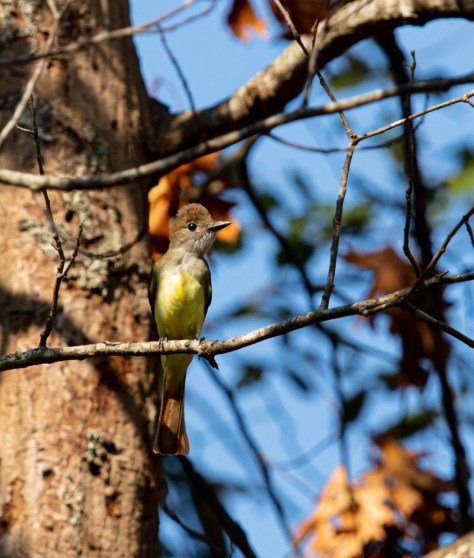
This Great Crested Flycatcher was a total camera hog as he fluttered from branch to branch among the limbs of the dying Oak tree in my yard. It’s not often enough that these hyper little birds will sit still long enough to get a good picture! 🌿 Great Crested Flycatchers are an edge-dwelling species: they prefer places where wooded areas adjoin grassy places. This is the reason why they seem to enjoy living on my property so much as this description fits my backyard here in central N.C. perfectly. They are also known to set up shop in unused woodpecker holes and will use shed snake skin to line their nests. Makes me wonder if they will stalk a snake waiting patiently for it to shed a crinkly nestling “mattress” for its young, lol!
I”m pleased to announce that eBird accepted my submission for a first White Ibis sighting at Harris Lake Park in New Hill N.C. from this past Friday. This being a “rare bird” sighting, I made sure to provide photos for verification when I submitted the checklist so that the researchers at Cornell could properly document this event.
This new record was super exciting! I had just stepped onto the dock at the lake when a flock of Ibis’s took off right in front of me. I barely had enough time to bring my camera up to snap off a couple of photos before they were gone. So glad to capture this unexpected rare bird sighting. Another great example of how much fun birding can be. One just never knows what surprise is waiting on the wing.
An Oak huge tree died suddenly in my yard here in Fuquay-Varina N.C. a couple weeks ago. Since then, there’s been a huge increase of birds fluttering in its boughs searching for bugs. From Woodpeckers to Wrens, Gnatcatchers and Nuthatches, it’s been interesting to observe a variety of species moving in and out of the tree.
Today brought a family of Great Crested Flycatchers like
this one which I photographed as he “posed” for a quick shot in the
morning sun.
Hi, Bill Jackson here,
travel and nature photographer in the Raleigh-Durham area. I have been
busy exploring some beautiful places in North Carolina since my recent
relocation from Puerto Rico.
This particular photo was taken on the west side of Shackleford Banks
just before sunset. Since the plumage was more textured than I would
expect, I consulted with a friend that knows a lot about birds, and she
indicated that it appears to be a Ring Billed
Gull or maybe a Laughing Gull that may be coming out of its breeding
plumage. She wasn’t 100% certain as species of gulls are sometimes
difficult to specify, and there is the possibility that this bird
resulted from cross-breeding since the gulls have been
known to do that. Certainly news to me and happy to have had the
assistance of someone that knows a lot more than me!
Be sure to check out my site for more bird, wildlife, and travel photos at
www.BillJacksonImages.com. You can also find me on Facebook and Instagram.
On my way down the path to my parked car at Jordan
Lake in New Hill NC, I spotted a couple of Blue-gray Gnatcatchers flying
erratically into the branch of an Oak tree. Upon closer inspection
with my zoom lens, there appeared a young one among the leaves who was
receiving bug snacks from mom and dad. He hardly made a peep and I
might have missed him but for the fact that he fluffed out his feathers
so quickly, that the brief movement caught my eye. 🌿 Blue-gray Gnatcatchers are carnivores and they always seem to on the hunt for tasty bugs. Their
diet is based on insects, spiders (nice!) and small invertebrates, yet,
despite its name, the Blue-gray gnatcatcher rarely eats gnats! I think maybe they should be renamed to “Blue-gray Nopecatchers” lol!
Since Cowbirds are known for laying their eggs in the nests of other birds, the question is how does a Cowbird learn how to be a Cowbird instead of a Warbler, Gnatcatcher, or Blackbird host? Researchers at the University of Illinois observed that the Cowbirds mother actually remained in the host birds territory and could hear the cries of her offspring. In response to hearing the begging cries of the baby cowbird, the females responded, not by feeding it, but by calling to it. The researchers think that this behavior may help the cowbird fledglings to eventually find other adult cowbirds that are vocalizing, as they fly from feeding areas to roosting areas at dusk each day. Nature is endlessly surprising! Photo by Sally Adams Siko Canon 5DS Harris Lake Park, New Hill North Carolina
Cowbirds are well known to lay their eggs in the nests of other birds, leaving the young to be raised by other species. So how do Cowbird chicks avoid imprinting on their host families of Gnatcatchers, Warblers or Blackbirds yet still learn how to be a Cowbird?
A study by the University of Illinois was launched to answer this question. Researchers tracked juvenile cowbirds that were being raised by Prothonotary warblers. They’ve discovered that, at around 30 days old, cowbird fledglings started to leave the warblers’ territory at dusk to roost alone. They would then return the following morning to be fed by their foster parents. For reasons that aren’t yet clear, these nocturnal departures seem to prevent the young cowbirds from imprinting on their host parents.
Interesting info for sure! But how exactly do Cowbirds learn how to be Cowbirds and not pick up on the habits of their host families?
I’ll post more on that question tomorrow… Photo by @sally_siko of Birdwatching NC Canon 5DS
While walking at the top of Jordan Lake dam in New Hill, N.C., a Great Blue Heron glided over the service road just a few feet in front of me. He was so close that I could hear the wind breezing a soft whoosh through his feathers. With a wingspan reaching nearly 6ft, they’re quite a sight in the air and they can cruise at about 25mph while in flight.
Went
exploring this morning at Jordan Lake dam in New Hill, NC and found
this Black Vulture sitting in the grass overlooking the water. What a
fascinating bird to see up close! Most vultures have bare skin on
their heads. One of the reasons why is this keeps the blood from their
meals from matting into their feathers. Another possibility is that
this bare skin helps cool the bird down on hot days, depending on how
far out they extend their neck’s. By changing their posture to
expose more or less of the bare skin on their heads and necks, vultures
could cut their heat loss by half in cold conditions and increase their
heat loss by almost a quarter in certain hot conditions, like those
which are found around here in North Carolina during the summer. 🙂 Photo by @sally_siko .
Bird watching tours, trips, adventures and birder news in North Carolina