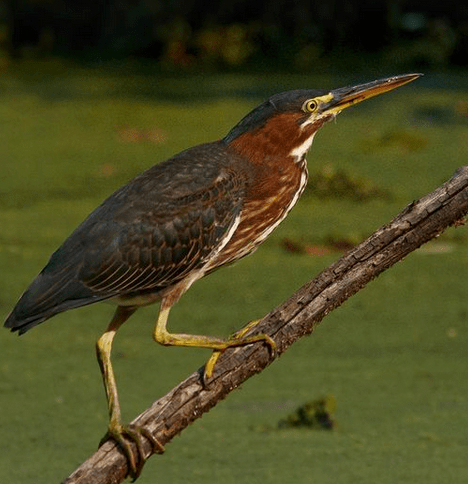
If you get the chance, it’s nice to take a few minutes to sit and watch a Green Heron hunting for a meal. I spotted this handsome guy while on a birding trip at the Pee Dee NWR in Wadesboro NC last weekend. He moved slowly, one foot methodically placed over the other, creeping at a snails pace as not to alert its prey hidden below the surface of the murky water below. The Heron struck twice but came up empty both times. Undeterred, he kept at at it eventually landing a small fish a little further out into the pond.
Like most other Heron species, Green’s prefer to spend their time wetland habitats such as marshes, bogs, swamps, creeks, ponds and lakes. Their diet consists of fish, frogs, toads, salamanders, snakes, crayfish, insects and even small rodents when the opportunity presents itself. During the winter, they’ll hunt for prey in brackish water so small crustaceans and mollusks will be on their menu too.
These handsome birds are found throughout the Tarheel state from March to October so you’ve still got plenty of time to go see one this year. That being said, a few Green Herons have been reported to spend the wintertime in our southeastern coastal counties which is pretty neat!
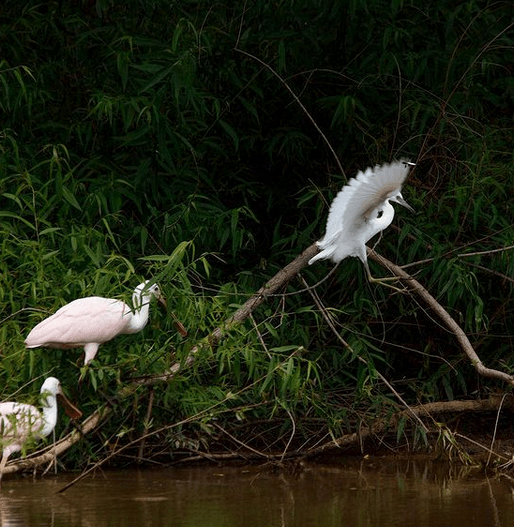
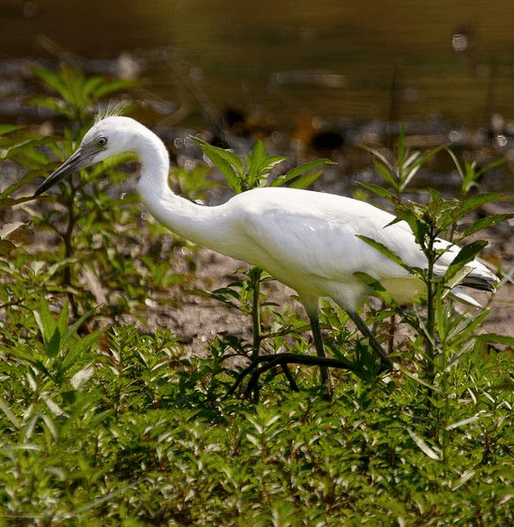
Earlier this month, a pair of Roseate Spoonbills caused quite a stir in the Triangle birding community by showing up at Lake Lynn in Raleigh. While these two were definitely a cool sight, they weren’t the only interesting bird to show up at Lake Lynn that day, check out this immature Little Blue Heron!
The young Heron was hanging out with the Spoonbills as they hunted for a meal together on the mud flats in the north end of Lake Lynn. The larger birds seemed to tolerate the young one as the Little Blue followed the pair of Spoonbills like a puppy, following their every step through the shallow water. Then, for whatever reason the Spoonbills decided to chase the Little Blue away.
The Heron tried to hide on a fallen willow branch but the Spoonbills pursued him relentlessly causing the Little Blue Heron to eventually make his escape by flying up into the higher boughs of a cypress tree. Not long afterwards, Great Blue Heron flew in and watched the Little Blue intently. Perhaps the larger Heron was eying the little one as potential meal lol! After an hour or so of sitting in the tree top, the Little Blue Heron ended the interspecies standoff by launching himself from the tree into the air flying south across the water, disappearing around the bend of the shoreline. Not long afterwards, the Spoobills headed out in the same direction…
Although they aren’t a particularly common sight at any location in North Carolina, coastal populations of Little Blue Herons are a year round resident of the Tarheel state and they’re also found here in the Triangle from June to August. They are usually spotted hunting for fish, invertebrates, frogs, small reptiles and insects in shallow freshwater marshes, ponds and on mudflats. Though it might seem that this elegant white bird is miss named, Little Blue Herons are indeed covered all over with a steel-purplish-blue colored plumage once they reach adulthood. What a beauty!
When bird watching in NC, one of the most instantly recognizable species is the male Northern Cardinal. A familiar sight both in our yards and in the woods, these vibrantly colored birds are found in all 100 counties across the Tarheel State. I spotted this handsome fellow at the NC Museum of Art Park yesterday morning hiding on a shady bough.
As the end of the nesting season draws near, the Cardinals will start to molt out their feathers which will be replaced by bright new plumage. Some of them even lose all the feathers on their head all at once! This one appears to have started the process as he’s looking a little rough around the edges.
The Cardinal’s signature crimson red colored feathers are a product of the birds diet of plants, fruits and seeds rich in carotenoids. Although there are plenty of options for them to snack on in the wild, you can grow plants right in your own backyard to help your local Cardinals keep their bright color. These guys love fruit like raspberries, blackberries and strawberries as these fruits are packed with the carotenoids the birds need. That being said, if you really want to impress your flock of Cardinals, plant a a Dogwood as those red berries produced by this flowering tree are by far and away their favorite backyard treat.
Though they are a common sight here in central NC, it’s tough to not stop and appreciate the beauty of a singing Indigo Bunting when out on a trail. I mean look at those colors! With that array of sapphire, turquoise and amethyst plumage sparkling in the sun, it’s a pallet that any jeweler would admire.
I found this Indigo Bunting at Bynum Bridge while leading a trip there last week. Perched on his twig, he sang constantly only stopping to chase away any other males who entered his territory. Interestingly, male Painted Buntings learn to sing their complex tunes from other males near their territory instead of from their parents. As a whole, these songs are repeated and may evolve into a certain kind of uniformity over the years which I’d loosely describe as a small localized accent or dialect shared by nearby males. In fact, a male Painted Buntings can tell when an intruder Bunting is ‘not from around here just by his song.
Painted Buntings are a summertime resident of North Carolina. Arriving in April to breed, they nest throughout most of the state and may be found in varying numbers in all 100 counties during the warmer months. Look (and listen!) for these gorgeous feathered gems in tall grassy fields, agricultural lands and in open clear cut areas containing grass and scrub brush. Btw, if you live in a rural area, Indigo Buntings can also be enticed to visit your yard (especially in the autumn) if you offer nyjer and millet seed in your feeders. They’ll stick around the Tarheel state until October so we’ve still got plenty of time to enjoy these beauties before the year is done.
When the summer heat rolls in, it’s nice to get out of the sunny fields and into the woods to cool off. We aren’t the only ones who appreciate the cool shade that the trees provide, Ovenbirds are masters of the shadows and remain active throughout the day even during the hottest hours. I found this one recently at the Pee Dee NWR while hiking along Wildlife Dr. in Wadesboro NC. It’s a quiet stretch of gravel road that provides a nice pathway through the thick deciduous forest which is the perfect habitat for spotting all kinds of birds and other wildlife.
Marveling at the lush green palette before me, I didn’t have to walk very far before hearing the Ovenbird’s loud call echoing in the woods and was stoked to be able to find it perched on a low branch just a few steps off of the road. So cool!
Ovenbirds favor mixed deciduous and coniferous forest areas which are semi open under the canopy yet still contain scrubby thickets and moderate brush. Though they look like Thrushes, they’re actually a species of warbler and like others in that family they are voracious eaters of insects. However like Thrushes, (and unlike most other warblers) Ovenbirds are usually spotted hunting for a meal on the ground scratching up under the leaf litter in search of beetles, worms and grubs.
Ovenbirds are a spring and summertime resident of North Carolina and are found across the state from the mountains to the coast from April to October. That being said, a few Ovenbirds have been found to spend the winter in Buxton Woods on Cape Hatteras Island in recent years. This is an interesting trend to watch as more people get out to go bird watching during the winter in the OBX. Pretty cool, huh?
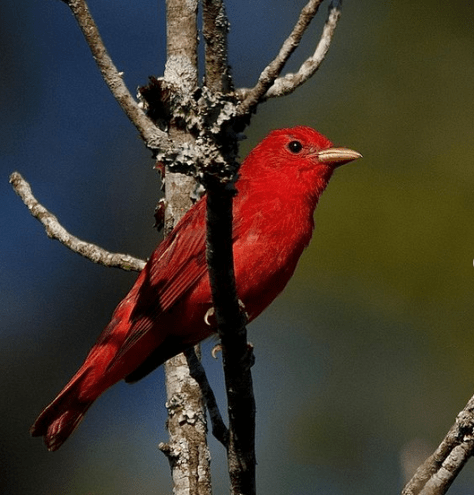
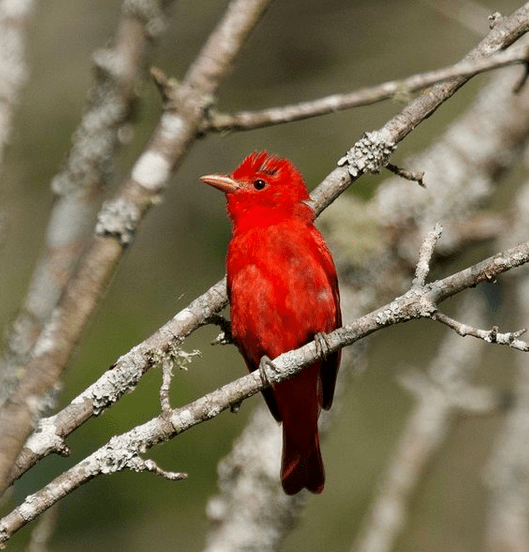
One can hardly hike more than a few minutes in the woods here in central NC without hearing the cheerful call of the Summer Tanager. This was the case when I spotted this male singing in the trees at the Pee Dee NWR in Wadesboro NC last week. He was easy to find with that bold red plumage, especially when he landed on the bare branches of a dead tree near the shoreline of the lake. Such a gorgeous bird!
Did you know that the Summer Tanager is the only entirely red colored bird found in the United States? Northern Cardinals and Scarlet Tanagers come close however both of those species also have black feathers on their bodies. All three species get their bold red hues from carotenoid compounds which produce the red (and sometimes yellow) colors seen in the birds feathers. These are acquired through their diets (mainly through fruit), and are then processed in the body into pigments that are deposited in the growing feathers.
Summer Tanagers are generally spring and summertime residents of North Carolina. They arrive in April and hang out until September before migrating south to Mexico, Central and South America. That being said, there are small but growing numbers of Summer Tanagers that stick around for the entire winter in the eastern part of the state provided that they have a reliable food source available to them via a feeder. Pretty cool huh? 🙂
Oh btw, I’ve posted new birdwatching tours to the Pee Dee NWR (where I photographed this Summer Tanager) here on this website. Wanna join me? Check out the link below for booking details.
One of my favorite birds to see when visiting the coast are the American Oystercatchers. With those bright orange eyes and red bill set off by that gorgeous brown, black and white plumage they’re one of the sharpest looking birds on the beach.
I was happy to see a couple of chicks zipping around the dunes and was pleased when one of the little ones stopped running long enough for me to grab a quick portrait. Isn’t he cute? 🙂
American Oystercatchers are a year round resident of North Carolina. During the summer months they are found nesting in our dunes. Although the breeding birds are a familiar sight along our beaches (like this one on Wrightsville) they’re most often spotted hunting for a meal in coastal areas where oysters are present such as on sandbars, tidal mudflats and along the rocky areas near jetty’s.
Oystercatchers feed almost exclusively on shellfish and other marine invertebrates including mussels and clams of many varieties, limpets, sea urchins, starfish, crabs, worms and of course oysters (shocking, yes I know haha!). One of the most striking feature of these handsome birds is that bright red bill. More than just a pretty facial feature, it’s actually the key tool they use for getting a meal. Wading through shallow waters over oyster beds, they’ll locate the oysters which are partially open. Once they spot one, they’ll stab at it, inserting their long knife-like bills into a mussels partially open shell, quickly severing the powerful adductor muscles before the shells can close. Then in proper ‘raw bar fashion, down the hatch the soft parts go. Makes me wonder if they ever have a hankering for a beer to wash it all down with lol!
A few weeks ago, I had the opportunity to visit a nesting colony of Black Skimmers on Wrightsville Beach. Watching the parents fly back and forth to bring food to their mates and chicks was absolutely fascinating. It’s such a joy to see new life thriving on the coast of North Carolina.
Black Skimmers typically nest as a large colony on the sand flats in between the dunes on our barrier islands. One to five eggs are laid into a depression in the sand and are incubated by both parents for around 23 days. The chicks break out of their eggs already covered in downy feathers and can even run around within a few hours of hatching. During the first few days, one parent will stay with the chick but shortly thereafter the little one will be left alone on the beach while both parents go off to catch its next meal. Despite their mobility, the little ones rely solely on their parents for food and usually scurry off to hide under some beach grass to await their parents return.
As it goes in large flocks, it’s only a matter of time until some bird drama goes down. In this case I watched a Black Skimmer trying to bring a fish to his chick. He wasn’t the only parent trying to feed his young though as a very aggressive Common Tern came swooping in to try and steal the Skimmers prize. Over and over the Tern dove, snapping at the Skimmer with every pass. I really thought the Tern would be successful given the speed of its attack. Yet, the Skimmer held tight to that fish and managed to endure the onslaught long enough to feed his hungry chick.
Interestingly, Black Skimmers often nest near or among Tern colonies, which (despite skirmishes like this one) can provide benefits fir the Skimmers, as the Terns will aggressively attack gulls and mammals that prey on the eggs and chicks of both species.
For the most part, the Skimmers and Terns ignored each other and there was peace to be found on this beach. In fact I saw far more squabbling between the Skimmers themselves as males super protective of their small territories around the nest.
Guarding the females against all other males, they use warning displays of force such as tossing their heads upward, standing upright, or facing down with the tail cocked up. Sometimes, the males spread their wings wide and opened their bills, exposing a bright red gape.
It wasn’t all about fighting though. One of the sweetest things to watch are the Skimmers courtship rituals. The males will fly in and present a fish to it’s chosen female. If she refuses the fish, he’ll eat it and go out to catch another to try again. If she accepts the gift, she’ll take the fish in her bill during the exchange and mate with the suitor immediately. Once the couples bond is established, they’ll parade through the area together with necks outstretched and bills held up for all to see.
Although you can find them on most of our coastal beaches, Black Skimmers are most often spotted feeding in our inlets, estuaries and other slow moving bodies of water.
One of their most striking features are it’s red-and-black bill and as you can see here, they’ve got a lower mandible that juts out farther than does the upper. When feeding, the Skimmer flies low over water with its beak open and lower mandible partially submerged. When the lower part of the bill touches prey, such as a small fish, the bill’s upper mandible snaps down like a mousetrap, securing the bird’s meal.
Black Skimmers are a year round resident of North Carolina but they do appear to migrate locally to the southern coast of the Tarheel state during the winter months. The Wrightsville Beach area is a wonderful spot to observe these handsome birds and it’s nice to know that there is a safe place for them to raise their families, thus securing a spot for the next generation of Skimmers to grace our shorelines.
Here’s a bird I was really happy to find during a recent birding trip to southeastern NC, an Anhinga! In fact I got lucky and was able to spot two of them (an immature and an adult) on the ponds at Airlie Gardens in Wilmington. Although I’ve seen this species before, these are the first photos I’ve ever captured of this large, prehistoric looking bird.
Anhingas are actually a species that is on the increase here in the Tarheel State. They favor habitats containing freshwater with cypress trees and are most often spotted hunting for a meal in swamps, ponds and lakes in the coastal plain and in the eastern Piedmont regions.
As you may have guessed, Anhingas eat a wide range of aquatic creatures such as fish, crayfish and frogs. They often dive underwater to catch their prey. Using their sharp bills, they impale their prey by piercing it straight through. Interestingly they’ve evolved with some unique ways to hunt underwater more efficiently. For one, they lack the water proofing oils found in duck species. Since (surprisingly) they’re not the strongest swimmers, they become waterlogged once their feathers become saturated. This added weight allows the Anhinga to dive deeper than it could if it was waterproof. Another cool feature of the Anhinga is that they do not have nostrils. This adaptation means they’ve got no worries about accidentally breathing in water while hunting below the surface. It’s neat that a bird that looks like it belongs in the Jurassic Period would actually be the one species which is holding the latest in cutting edge freshwater hunting physiology, lol!