Tag Archives: best life birding birdwatching trips

A Scissor tailed Flycatcher at Ft.Fisher NC

By Sally Siko

Happy to have caught a few good shots of a rarity in North Carolina, a Scissor-tailed flycatcher!
I was lucky to spot it last month along the ATV / off road beach access trail at Ft. Fisher.


I’d spent a few minutes walking along the adjacent Basin Trail when the path veered left towards the beach.
Knowing that flycatcher’s typically like to perch on places which give them maximum visibility in open areas (fences, power lines ect.), I decided to head towards the beach and out of the marine scrub forest.
As it turned out, this was the right move because I spotted the flycatcher just a few yards ahead on the right, sitting on a post in the dunes next to the trail.


Affectionately nicknamed the Texas bird-of-paradise, these long-tailed birds are members of the kingbird family.
Measuring nearly 14in long, Scissor-tailed Flycatchers are relatively large birds. Not surprisingly though, half of their total body length is that deeply forked black and white tail that is nearly a nearly unmistakable ID point when referencing them in the field.

The reason why this bird is a special sighting in the Tarheel State is because their range typically extends from eastern Colorado and Nebraska down south to Texas and Western Louisiana. Isolated breeding patches of these feathered gems have been found in Mississippi, Alabama and Tennessee.
Why it’s shown up in southeastern NC is anyone guess!
I hope that I’ll encounter this beautiful species again next spring during my High Island TX birding tour (learn more about this trip here!) because I’d love to share the experience of seeing one for the first time with my east coast guests 🙂

Photos by @sally_siko of @bestlife_birding on my beloved full frame 50MP beast, the mighty @canonusa #5Ds
A Worm eating Warbler at Indian Creek in eastern Kentucky

By Sally Siko

Here’s another shy species of warbler which I was stoked to see in the woods while birding at Indian Creek in the Red River Gorge area of eastern Kentucky, a Worm eating Warbler!
Yeah I know he’s not as brightly colored as other species, but I think they’re elegant birds which are interesting to watch while they hunt for a meal.
This little guy moved fast along a brushy steep slope, working the cover nearly as quickly as a Ruby crowned Kinglet does when looking for a six legged snack.
It was pretty challenging to photograph this bird since it was hanging out in a dark patch of the woods. Still it was fascinating to see one of these little beauties up close, plus being able to add him to my yearly eBird list was a definite win.
In the end, patience paid off and I did get off a couple decent shots when it flew up a little higher out in the open to perch on a sparsely leafed sapling in better light.
Success!


As it so often goes with other species of birds, the Worm eating Warbler IMO is misnamed lol! They do not pull earthworms from the soil as American Robins do, rather this insectivore gleans its diet (insects and their larvae as well as spiders) from foliage.
A hungry Worm eating Warbler uses tactics such as probing curled live or dead leaves for hidden prey while hanging (sometimes upside down) from a twig or small branch, probing crevices, fluttering from limb to limb in order to grab flying prey while picking off slow-moving insects from open leaves and young twigs.


Worm eating Warblers breed in the Appalachian mountains and despite their shy disposition are relatively easy to find from late April through early October.
Their seasonal range extends from southern New York, west into southern Michigan and east Texas, all along the mid Atlantic states of the US and down into Central America.
Look for them in large tracts of deciduous and mixed forest, particularly in those with moderate to very steep slopes and patches of dense understory shrubs.

Photos by @sally_siko of @bestlife_birding on my beloved full frame 50MP beast, the mighty @canonusa #5Ds

Behind the scenes of Best Life Birding trip to the Blue Ridge Mountains

“When you arise in the morning, think of what a precious privilege it is to be alive-to breathe, to think, to enjoy, to love.”
Marcus Aurelius -Meditations

Had a good time birding in the Blue Ridge Mountains yesterday…
Because Isaac & I like to make the most of every second of sunlight, we set out at 2:30 am to arrive early enough to start the day at sunrise.

The weather was not ideal for a 4hr road trip, with rain and dense fog making it a challenge to drive in the dark through those winding curves.
The higher we climbed, the thicker the fog became, dropping visibility down to about 3ft at times!
Finally we ascended high enough to break through the mist and the skies became a clear blue with growing orange light in the east.
Although it was cold (in the 30s) it was well worth the time to stop on a ridge to step outside to watch the sun come up over what looked like an ocean or glacier field of clouds.
Truly an incredible sight well worth getting up early for 🙂


At the end of the day it was honestly a tough decision to set off to the east to return to the Raleigh area.
I did not want to watch those blue peaks receding in the rear view mirror, but my heart & responsibility calls me elsewhere in this season of life.
Still, leaving the mountains behind always makes me immediately homesick for a place I’ve never lived since I’ve dwelled primarily in suburban flat-land for most of my life.
A peculiar feeling for sure!
Someday I hope to change that & wake up to a cloud deck at my feet every morning 🙂

And the birds? Oh yes we found a ton of beautiful species out there which will be of use for my guests needs on future trips.
We snapped off several great shots of some tough to find warblers and even managed to tick off a rare species for good measure.
A kick ass day of birding!
More to come on that soon on bestlifebirding.com

Eastern Screech Owls in Lexington, KY

By Sally Siko

Last year I was tasked with assisting @isaacmcshanephoto in an effort to help him reach 200 bird species on his 2021 eBird list.
It came down to the wire on December 30th with success found in the form of a Virginia Rail at the Roanoke Island State Gamelands.
Happily, Issac was able to return the favor last week in getting me my 200th bird for 2022 with these adorable Eastern Screech Owls!


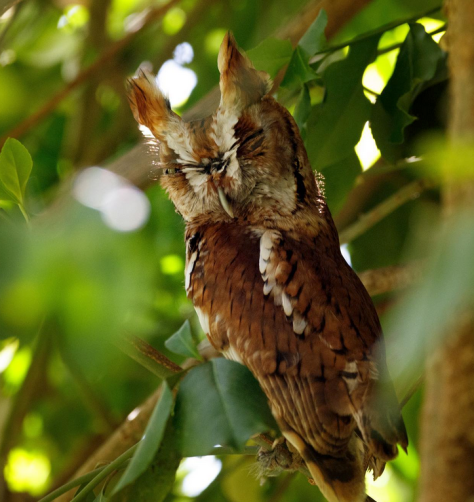
We were so excited to spot the little fluff balls in their nest box at the University of Kentucky Arboretum (bike path). Although I’d heard their calls over the years, I’d never seen a Screech Owl before so this encounter was truly special, one I’ll never forget.


Yet, there was more owl fun in store for us…
These birds are small and are pretty hard to spot during the day so imagine my surprise when I randomly found a third one (an adult) perched in a mass of vines while hiking a trail later that same day. We spent about 20 minutes photographing the adult who didn’t stir a inch from his resting spot. In fact, the bird only moved once briefly during the entire encounter to get a better look at us before closing its eyes to rest.
So cool!


As their name implies, Eastern Screech Owls are found throughout most of the eastern and central parts of United States from Florida to New England and west from Texas to the Dakotas.
As widespread as the species is, you’d think that they would be a common sight, yet their small size (only 6-10 inches in length) and nocturnal habits make them a difficult bird to find in any region.

Screech owls occur in a wide variety of habitats, particularly wooded suburban neighborhoods and parks, riparian areas, orchards, and woodlands near marshes, meadows, and fields.
My best advice is to listen for their distinctive, whinny-like calls /low-pitched trills and look for them moving between the open areas of fields into wooded areas at dusk and after dawn.
Or, just head over to the UKY Arboretum this month and enjoy the little ones while their still here 😉

Photos by @sally_siko of @bestlife_birding on my beloved full frame 50MP beast, the mighty @canonusa #5Ds

A Bobolink encounter in Pittsboro NC

By: Sally Siko

Each spring, flocks of migrating Bobolinks return to central NC to stop off for a few days to rest & recharge on their journey to their breeding grounds in the northern US and Canada.
The best spot to see them in the Triangle is in the fields along Mid Pines Rd in Raleigh.
That being said, these flocks are usually spotted far out in the fields making them a little tough to see without a scope, a long lens or bins.
That’s why I was so excited to get a close up encounter with one near Bynum Bridge in Pittsboro about 3 weeks ago!
It was so cool to actually be able to get a proper look at one of these beauties as it hopped around the brush on it’s never ending search for insects hidden in the leaves.


Bobolinks are about the size of a house sparrow, approximately 6.3–7.1 in long from the tip of the beak to the end of the tail.
Perched on a grass stem or displaying in flight over a field, breeding male Bobolinks are striking! No other North American bird has a white back and black underparts (some have described this look as wearing a tuxedo backwards lol!). Added to this is the male’s rich, straw-colored patch on the head and his bubbling, virtuosic song. Once summer ends, he’ll molt into a buff and brown plumage.


As mentioned above, Bobolinks are mostly a migratory visitor to the Tarheel state showing up for just a few days in the spring and autumn.
Yet, in recent decades this species has been observed nesting in the grassy meadows of western NC in increasing numbers which is pretty neat!
Elsewhere throughout the state, look for them in dry grass lands from late April-early May and in wetter fields/marshes again in late August through early October.

Photos by @sally_siko of @bestlife_birding on my beloved full frame 50MP beast, the mighty @canonusa #5Ds

Love is in the air- Northern Cardinals at Bynum Bridge NC

By: Sally Siko

It’s springtime and love is in the air.
At least so it goes with this pair of Northern Cardinals I spotted while birding last week near Bynum Bridge in Pittsboro NC.
It was so sweet to see the male fly in and land on a branch next to his mate to present her with a juicy green caterpillar.
A tender moment of bird wooing to be sure but is actually part of of an array of elaborate courtship rituals that the couple engages in year after year to strengthen their bond.

Our official state bird, the Northern Cardinal is a year round resident of North Carolina and are found in every county from the coast to the mountains foraging for a meal in areas of dense brushy undergrowth or in hedges.Cardinals are of course a familiar backyard visitor too. They usually are seen on the ground below our feeders picking at the fallen seed.

Though they’re indeed numerous, I still enjoy photographing them whenever possible. That color is irresistible to me from a creative perspective.
Plus, whenever I see a Cardinal I’m reminded how important it is not to take a moment (or a bird) like this for granted.
After all, Cardinals may be common around here, yet they are someone else’s Life Bird in other locations. Thus seeing one is extra special anyway one looks at it 🙂


Photos by @sally_siko of @bestlife_birding on my beloved full frame 50MP beast, the mighty @canonusa#5Ds

Good to see the American Redstarts are back in NC

By: Sally Siko

Green leaves are sprouting out on all of the trees, it’s really starting to look like springtime here in central NC.
The treetop canopies are becoming dense now bringing the arrival of hatching insects which are closely followed by flocks of migrating Warblers such as these beautiful American Redstarts.


With that bold black and bright orange plumage and their loud calls echoing through the woods, male Redstarts are impossible birds to ignore when hiking along a trail.
*Not that I’ve ever thought of ignoring them lol!
These birds are freak’n gorgeous and although they’re relatively easy to find, I’ve spent many hours trying to catch a proper photograph of one for years but with no luck.
Happily I finally came close with these shots which I took while birding in Bynum NC last week.

One of the nice things about this species of warbler is that when flocks of them move into the area, they’re relatively easy to find and photograph.
This is because Redstarts tend to hunt for food in the mid to lower understory of open deciduous woodlands, forest edges, near roadside trees, in open areas like orchards, shrubby edges of streams and ponds, brushy edges of sunny pastures, and suburban parks.
Or to put it another way, unlike many other species of warblers you won’t break your neck or hurt your eyes by searching for them high up in the trees of a dark forest lol!


The American Redstart is a somewhat unusual bird in that they’re both a breeding resident and transient migratory visitor to North Carolina with populations fluctuating wildly in different regions throughout the year.
They are known to nest in both the mountains in the western part of the state and along a narrow north/NE to south/SW strip in several of the counties in central NC which is kinda odd.
Generally though your best bet in finding them is from late April through mid May (aka. like right now!) and then again from September through early October during migration periods.
Get out there and enjoy them!

Photos by @sally_siko of @bestlife_birding on my beloved full frame 50MP beast, the mighty @canonusa #5Ds

The Ruby throated Hummingbirds are back in the Triangle of NC

By: Sally Siko

Now that spring is here, flowers are beginning to bloom and thus our gardens are filled with the delightful thrum of the wingbeats of Ruby throated Hummingbirds searching for a sweet snack.
I was happy to see this tiny green feathered gem while birding last week in Holly Springs NC. Though it was tough to photograph this fleet little bird in action, I enjoyed the challenge of trying to capture a beautiful frame from a respectful distance.


As is the case with most species of hummingbirds, Ruby-throated’s dine primarily on nectar and small insects. They’ll occasionally supplement their diet with tree sap if nectar is not readily available nearby, an important dietary adjustment which is particularly helpful for the few that call south eastern NC home during the winter months.
A familiar backyard bird to many here in the Carolinas, Ruby’s are best found feeding on clusters of red or orange flowers such as coral honeysuckle, jewelweed, bee balm, red buckeye, trumpet creeper, and red morning glory.
Most of the time they’re spotted with wings buzzing while hovering at a flower but they’ll stop and land to drink nectar from a conveniently located perch at backyard feeders too.


Ruby-throated Hummingbirds are considered medium to long-distance migratory birds. They breed in the eastern United States and southern Canada, then fly south for winter to Central America and south of Mexico.
That being said, a small but growing population of Ruby’s are choosing to spend the cooler months in the Wilmington NC area.
But, that is a long time off as we have only just begun a new year of enjoying these tiny feathered dynamos.
Cheers to the season ahead!

Photos by @sally_siko of @bestlife_birding on my beloved full frame 50MP beast, the mighty @canonusa #5Ds

New Birding trips are here just in time for migration

Now that spring has sprung in the Carolinas, it’s an exciting time to be a bird watcher!
Migration is getting underway and with it brings tons of beautiful birds into our state.
They’ll be a lot to see over the next few weeks and you can bet I’ll be out there birding and trying my best to grab some cool photos along the way.

Want to join me?
I’ve got 9 birding tours available for booking in destinations in North Carolina & South Carolina between now and June 30th.
Space is limited for these trips so reserve your spot today!
Looking forward to going birding with ya and cheers to a wonderful season ahead 🙂

Details and trip calendar links are found below!!!


-Sally Siko
Best Life Birding