Tag Archives: birding north carolina

Yellow-throated Warbler autumn migration at Jordan Lake SRA

Here’s another bird I’ve been seeing in higher numbers this year, the Yellow-throated Warbler.
These little gems seem to pop up everywhere I’ve gone birding in North Carolina since May and I couldn’t be happier about it 🙂


I spotted the bird in the first photo a few days ago at Ebenezer Point in Pittsboro NC and the second bird this past May at Yates Mill Park in Raleigh NC.

Perhaps the reason why “warbler neck” is a thing, Yellow-throated Warblers are best spotted in the mid to high canopy of the trees searching for insects and spiders as they pry into crevices along branches.
Unlike other warblers that move quickly and sporadically while hunting for food, Yellow-throated’s are slower moving and deliberate when hunting as they scour the branches, leaves, and ground for a snack.
This makes them a bit easier to observe and photograph which is always nice lol!

Arriving in late March Yellow-throated Warblers may be found throughout most of the state however they are somewhat more common in our eastern counties.
Look for Yellow-throated’s in varied habitats like dry pine stands and also in the tall trees growing along shorelines of ponds, lakes and streams. They are also fond of swampy areas too which makes for a pretty diverse range of opportunities in which to find them.
Unfortunately they will be leaving NC soon to head south for the winter so try and get out and see them this week or you’ll have to wait until spring to enjoy these delightful little birds again.

Photos by @sally_siko of @birdwatching_nc on my twin mighty megapixel dragons the @canonusa#R5 & the #5Ds
Enjoying the Cape May Warblers at Jordan Lake SRA

It’s not often that I’ll post the same species of bird twice in a week but there were tons of Cape May Warblers putting on a show at Ebenezer Point at Jordan Lake in Pittsboro North Carolina recently.
It was great to see so many of them flitting through the trees, chasing each other while feasting any six or eight legged snack that dared cross their path in the canopy.


These lovely warblers were named for the county of Cape May, NJ where the species was first noted in scientific literature.
Sitting at the southern tip of New Jersey, bordering the Delaware Bay and the Atlantic, Cape May county is the premier destination for migrating birds along the east coast of the US.

Though Cape May Warblers stop in NJ when traveling between their breeding & wintering grounds, they are hardly alone as hundreds of different bird species are found in Cape May county every year during each migration cycles.
It seems like an odd name to give these beauties as it hardly describes any of the species unique characteristics.


Given the Cape May’s preference for nesting & feeding in conifer forests, perhaps a better name might be spruce warbler or maybe even tiger warbler since they sport those bold black stripes on it’s warm yellow breast.
Moniker choice aside, these feathered gems are standout birds in my eyes and I’m always grateful to catch a glimpse of Cape May every autumn.

Photos by @sally_siko of @birdwatching_nc on the mighty mirrorless monster of a camera, the @canonusa
#R5

Hooded Warblers at Brumley North Nature Preserve, Durham NC

Here’s a bird I was pleased to find a few weeks ago, a Hooded Warbler!
I spotted this handsome little guy while birding at the Brumley North Nature Preserve in Durham, NC.
Normally Hooded’s stick to the dark, dense undergrowth areas in a forest so it was neat to actually get a glimpse of one perched on a branch (relatively) out in the open.
Although I wish that the lighting had been better in this series of portraits, I’ll take what I can get with this shy species.


Hooded warblers are unusually territorial.
In fact the males and females have their own territories marked and do not cross them unless for breeding.
Males and females even make use of different habitats during the winter. The males spend the cooler months in mature forests while the females frequent shrubby and swamp areas.
It is said that “distance makes the heart grow fonder”, at least so it goes with Hooded Warblers when breeding season arrives haha!


These feisty little birds will stick around NC for just a couple weeks more before heading south to warmer locals in the Caribbean, Mexico, and Central America for the winter.
When they return next April, you can find them across most of the state except for on our barrier islands.

Photos by @sally_siko of @birdwatching_nc on the mighty @canonusa
#5ds

Pine Warblers at jordan Lake SRA

With so many species of seldom seen migratory warblers flying in for a quick visit to the Tarheel state, year round residents such as the Pine Warbler are often overlooked when autumn arrives.


That’s a shame because these tiny yellow fluff balls are quite charming in their own right.
Happily they aren’t as shy as most other warblers and are even frequent visitors to our yards throughout the year, especially if you have provided a suet feeder for them to snack on.

I spotted this one at Ebaneezer Point on Jordan lake yesterday morning.
It was neat to watch him moving through the branches to locate a suitable breakfast. In this case, an insects egg sack hit the spot.


As their name suggests, Pine Warblers are best found in stands of pine trees hunting for a six or eight legged meal. Their diet mainly consists of insects yet when winter arrives they change their diets to include pine nuts, seeds, fruits and berries. This unique digestive adaptation allows them to get the nutrients they need even when insects are scarce.

Photos by @sally_siko of @birdwatching_nc on the mighty @canonusa
#5ds

Blackburnian Warblers at Bynum Bridge in Pittsboro NC

Autumn migration is an exciting time. It brings the opportunity to be surprised and delighted with unexpected finds when we step outside to go birding.
Case in point, this lovely Blackburnian Warbler. I encountered the one featured in the first 3 photos recently at the Old Bynum Bridge in Pittsboro NC while it was hunting for a meal in the trees.


As you can see, the Blackburnian Warbler goes through some pretty big changes appearance-wise during the fall. Their familiar bright orange, white and black breeding plumage (as seen in the last photo in this post which was taken in June) are replaced with a muted palette of warm grey, soft grey and charcoal tones.
Though the Blackburnian isn’t as showy this time of year, I think they are still a lovely sight.


Nesting exclusively in boreal forests, Blackburnian Warblers are a summertime resident in the higher elevation areas of western North Carolina. Elsewhere across the state they occur as migratory visitors just passing through.
The best way to see them is to head out to the Appalachians during late April and early May when the breeding season gets underway. At this time, the trees haven’t fully leafed out yet so they’re somewhat easier to find when singing at the treetops.

Back here in the Triangle, we’ve just got a few weeks left to spot these beauties before they head south to the mountain forests of the Andes mountains in South America.

Photos by @sally_siko of @birdwatching_nc on the mighty @canonusa
#5ds

A Yellow Warbler encounter at Jordan Lake SRA

Here’s a bit of feathered sunshine to brighten your day, a Yellow Warbler!


I was pleasantly surprised to find a pair of them yesterday afternoon while birding at Jordan Lake in central NC.
It was neat to be able to catch a good look at these beauties hunting for insects in a stand of trees along the shoreline.

Yellow Warblers are true omnivores and are able to adapt their diets to suit the bounty of a given season.
During the spring and summer, their diet is based on insects such as leafhoppers, beetles, wasps, midges and caterpillars. They are often seen hovering over tree branches as they glean to catch the flash of light reflecting off of an insect’s wings.
When the weather cools, berries and fruits may also be consumed during the autumn winter months to supplement their normal diet when insects are scarce.


Unfortunately these gorgeous birds won’t be in North Carolina much longer in 2021 as they’ll soon migrate to locations in Central America and northern South America to spend the winter.
If you missed them this year, no worries they will be back again here in the Tarheel State sometime around mid April 2022.

Photos by @sally_siko of @birdwatching_nc on the mighty @canonusa
#5ds

Scarlet Tanagers in North Carolina

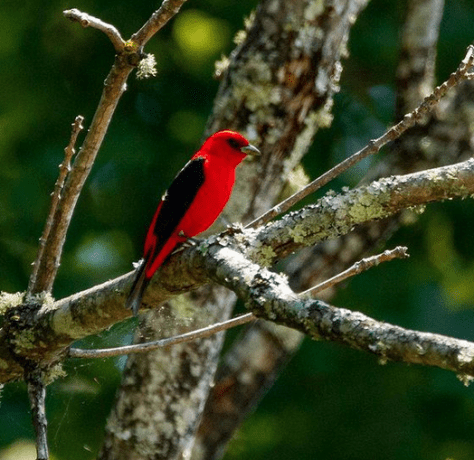
Here’s a bird that I’ve struggled to get a good photograph of, the Scarlet Tanager.


The first few photos show a handsome male that I found along the Blue Ridge Parkway back in June.
While he did sit patiently as I took photos, unfortunately the closest view I had was from about 100ft away. Thank goodness for a zoom lens lol!

Finally though, this past weekend I got a great close up look at a female at the Old Bynum Bridge in Pittsboro NC.

Although she’s not as brightly hued as her crimson & onyx mate, female Scarlet Tanagers are quite lovely dressed in their autumn gold & charcoal plumage.

Scarlet Tanagers are a summertime resident of central and western NC. They are found in deciduous forests containing mature hardwoods.
Unlike their relative the Summer Tanager, Scarlets are secretive creatures preferring to nest and hunt for a meal in areas away from people.
If you’d like to try and attract these beauties to come out of the woods to visit your yard try planting raspberry, huckleberry, serviceberry, mulberry, strawberry, and chokeberry on your property.
These gorgeous birds will stick around for just a couple more weeks before migrating south for the winter.
Do keep in mind that Scarlets are also fond of eating jelly, cherries, oranges, suet and mealworms so offering these items in your feeders may be enough to entice them to visit you when they return to the area next April.
Aren’t they lovely?

Photos by @sally_siko of @birdwatching_nc on
the mighty @canonusa
#5ds

Spending time with a Yellow-throated Vireo at Brumley Nature Preserve

Every once in a while, I start seeing certain species of birds more often than others.
In this case I’ve noticed Yellow-throated Vireos seem to be flying around NC in greater numbers than in the past 5 years.
I spotted this one snacking on a caterpillar at the Brumley North Nature Preserve this past weekend.


While I don’t know the exact reason for the influx (it could just be luck-right place/right time scenario) I’m certainly happy to to have the opportunity to photograph them again without much effort.

Yellow-throated Vireos favor a different habitat preference to their more often seen relative, the White-eyed Vireo. They tend to shun pine barrens are best found foraging in the high canopy’s of the treetops in old growth deciduous forests and occasionally near wooded streams.
Interestingly, the Yellow-throated and White-throated Vireos share similar calls so finding one isn’t too difficult if you know what to listen for depending on if your in the woods vs. the field.


These cheerful little guys will stick around NC for just about a week or so before heading to their wintering grounds in Central and South America, south Florida and on through to the coast of Texas.
Get out and enjoy them while you can!

Photos by @sally_siko of @birdwatching_nc on the mighty mirrorless monster of a camera, the @canonusa
#R5

Woodducks at Hinson Lake, Rockingham N.C.

Of all of the duck species we’ve got flying around NC, perhaps the most beautiful is the Wood Duck.
I was lucky to find several of them yesterday morning while birding with @latta.ridge at Lake Hinson in Rockingham.
It was thrilling to watch this small flock swimming around and preening on the water.


Wood Ducks are a year round resident of North Carolina though they appear to migrate locally to our eastern counties once the weather turns cold.
During the summer they are found throughout the state from the mountains to the coast.
Males are unmistakable to ID with those gorgeous colors, yet the hens (as seen in the last photo) are quite lovely too dressed in soft grey plumage punctuated by those colorful purple speculum feathers.


As their name implies, Wood Ducks favor fresh water wetland habitats with wooded shorelines such as ponds, marshes, swamps and bogs. Unlike other waterfowl, they are cavity nesters and will take up residence of unoccupied woodpecker holes in trees and nest boxes.
In fact, I’ve had the best luck spotting Wood Ducks in areas where Red-headed Woodpeckers are found as the two species seem to favor similar habitats.

Photos by @sally_siko of @birdwatching_nc on the mighty mirrorless monster of a camera, the @canonusa
#R5

Breakfast with a Snowy Egret in the Carolinas