Tag Archives: brumley nature preserve birding

Yellow- bellied Sapsuckers at Brumley Nature Preserve in Chapel Hill, NC

By Sally Siko

Like many of you out there in the eastern US this week, I’ve been stuck inside over the past few days due to rain and then extra chilly weather.
It’s been driving me nuts to stay cooped up indoors for so long!
Finally, I had an opportunity to get outside today to go birding with a guest at the Brumley Nature Preserve.


It was a balmy 21 degrees *lol!* when we got started but despite the cold we did manage to find and photograph several interesting species of birds including this Yellow-bellied Sapsucker.
I really enjoyed getting this series of shots as that bright winter blue sky contrasted perfectly with the black, white, yellow and red plumage of this beautiful little woodpecker.


Yellow-bellied Sapsuckers are found in varying numbers from our mountains to the coast throughout the year.
While this bird was busy gorging himself on wild persimmon fruit (check out his messy bill lol) usually they are spotted (errr heard) pecking loudly on the trunks of trees.
But why are they constantly hammering their beaks into the tree trunks?
The clue is actually wrapped up in their name. It’s all about that sweet, sweet sap flow!
These little guys will move up hastily up and down trees to drill a series of wells in the trunks to drink the sap that oozes forth. Often returning to the same tree on a regular basis, the Yellow -bellied Sapsucker’s elaborate systems of sap wells are maintained daily to ensure sap production.
Boasting a legit honey-badger-don’t-care attitude, these feisty woodpeckers will defend their wells from all kinds of sap-stealing animals and birds, including other sapsuckers. They also may be found happily raiding both hummingbird and suet feeders alike in our own backyards with the same energy.
Isn’t he marvelous?

Photos by @sally_siko of @bestlife_birding on my mighty 50MP monster, the @canonusa #5Ds
A Wilsons Warbler at Brumley Nature Preserve, NC

By Sally Siko

It’s the last week of May and spring migration is winding down here in central NC.
Luckily, (with the help of @latta.ridge ) I was able to get a good look at a lone male Wilson’s Warbler last week at Brumley Nature Preserve.
These handsome birds breed across the entirety of Canada and into Alaska which is why I was excited to catch a glimpse of a Wilson’s on his hurried journey north.


A somewhat rare sighting in the Tarheel state, Wilson’s Warblers are spotted here only during migrational periods.
They are tiny birds measuring 4.7” in length which makes them kinda tough to spot in the brush.
To make matters more difficult, Wilson’s prefer to hide out in dense willow thickets and dark forests with a water source nearby.
Their yellow plumage seems to absorb the green light of the sunshine filtering down through the leaves which provides an effective camouflage while they flit about on the branches. This makes them a challenging bird to find and photograph!
Though I spent about 15 minutes observing this one, I only managed to capture this single photo from the encounter as the tiny bird emerged from the woods to a field’s edge.

Wilson’s Warblers are found in central and eastern (rarely in the mountains) portions of North Carolina in mid to late May and again from late September through early October.
There still may be a few hanging around out there right now so be on the lookout this week!
Otherwise you’ll have to wait for autumn for another chance at seeing these beautiful feathered gems.

Photos by @sally_siko of @bestlife_birding on my beloved full frame 50MP beast, the mighty @canonusa #5Ds

Hooded Warblers at Brumley North Nature Preserve, Durham NC

Here’s a bird I was pleased to find a few weeks ago, a Hooded Warbler!
I spotted this handsome little guy while birding at the Brumley North Nature Preserve in Durham, NC.
Normally Hooded’s stick to the dark, dense undergrowth areas in a forest so it was neat to actually get a glimpse of one perched on a branch (relatively) out in the open.
Although I wish that the lighting had been better in this series of portraits, I’ll take what I can get with this shy species.


Hooded warblers are unusually territorial.
In fact the males and females have their own territories marked and do not cross them unless for breeding.
Males and females even make use of different habitats during the winter. The males spend the cooler months in mature forests while the females frequent shrubby and swamp areas.
It is said that “distance makes the heart grow fonder”, at least so it goes with Hooded Warblers when breeding season arrives haha!


These feisty little birds will stick around NC for just a couple weeks more before heading south to warmer locals in the Caribbean, Mexico, and Central America for the winter.
When they return next April, you can find them across most of the state except for on our barrier islands.

Photos by @sally_siko of @birdwatching_nc on the mighty @canonusa
#5ds

Spending time with a Yellow-throated Vireo at Brumley Nature Preserve

Every once in a while, I start seeing certain species of birds more often than others.
In this case I’ve noticed Yellow-throated Vireos seem to be flying around NC in greater numbers than in the past 5 years.
I spotted this one snacking on a caterpillar at the Brumley North Nature Preserve this past weekend.


While I don’t know the exact reason for the influx (it could just be luck-right place/right time scenario) I’m certainly happy to to have the opportunity to photograph them again without much effort.

Yellow-throated Vireos favor a different habitat preference to their more often seen relative, the White-eyed Vireo. They tend to shun pine barrens are best found foraging in the high canopy’s of the treetops in old growth deciduous forests and occasionally near wooded streams.
Interestingly, the Yellow-throated and White-throated Vireos share similar calls so finding one isn’t too difficult if you know what to listen for depending on if your in the woods vs. the field.


These cheerful little guys will stick around NC for just about a week or so before heading to their wintering grounds in Central and South America, south Florida and on through to the coast of Texas.
Get out and enjoy them while you can!

Photos by @sally_siko of @birdwatching_nc on the mighty mirrorless monster of a camera, the @canonusa
#R5

Birding at Brumley Nature Preserve: A Yellow breasted Chat

By: Sally Siko

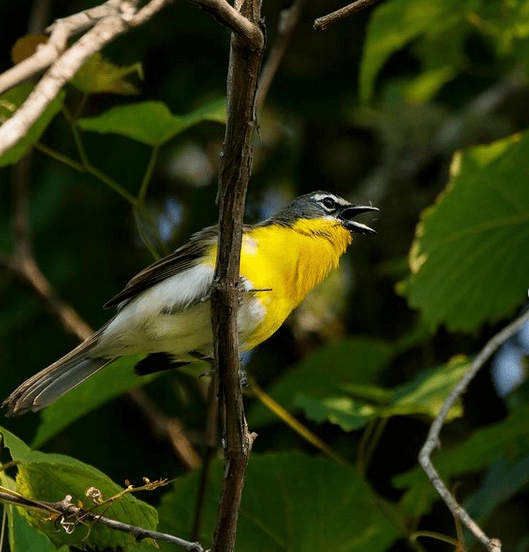
While birding at the Brumley Nature Preserve in Durham NC, I heard a loud, familiar call coming from above me in the trees. Scanning my eyes through the leaves, a bright patch of yellow caught my eye as I hurriedly lifted my lens to get a better look.
There, high up in the branches was this handsome Yellow breasted Chat!
Since he never flew down any lower I was only able to catch a few somewhat decent photos of him from below (would have rather captured an eye-level shot) but gosh I was happy to see him.


Measuring up to 7.5 inches in length, Yellow breasted Chats are the largest species of wood-warbler in the United States.
Other than those bright colors and similar habitat preferences, they share little in common with other warbler species.
The most noticeable difference are their songs which are best described as a weird mix of chattering clucks, croaks, rattles, squawks, mews, gurgles and popping noises.
They even make a call which sounds to me like the first note of a Bobwhite whistle.

Another key difference is their bill which is proportionally much thicker than that of other warblers. It sort of reminds me of a Tanager bill.
Like Tanagers, Yellow breasted Chats are fond of eating bees, wasps and other insects as well as berries and other wild fruits when insects are scarce.


The key to finding Yellow breasted Chats is to listen for them. They are quite loud and are relatively easy to locate by their calls.
Look for them where the woods meet the fields, in clear cut open areas containing stands of scrubby low brush or young saplings, especially in places where there is a water source available.
They’ll spend the summer in NC, sticking around until late September so you’ve still got a few months to enjoy them before the season is done.

Photos by @sally_siko of @birdwatching_nc on the full frame beast of an SLR, the mighty @canonusa
#5Ds