Tag Archives: white eyed vireo

White eyed Vireo nesting season in North Carolina

By Sally Siko

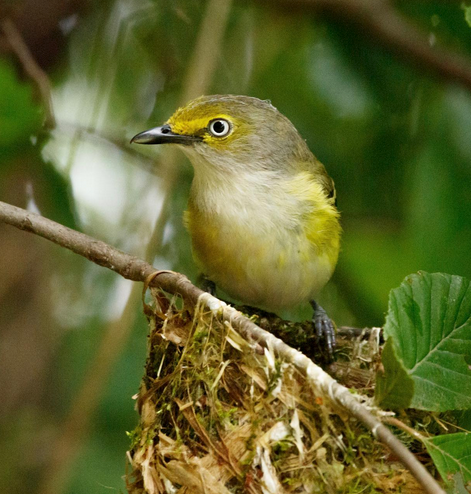
One of my favorite birds I spotted while sitting by the creek at the Croatan NF in east central NC was this White eyed Vireo. It was quite easy to find this bird as he kept calling out loudly from the brush down at the waters edge. These Vireos are also easy to ID with those one of a kind, light blue eyes. I’m not sure why they’re called “white eyed” although it could be the color of the sky reflecting in their eyes that gives them that slight azure hue.


White eyed Vireos are the only members of the Vireo family that prefer to forage and nest in the understory of forests and brushy areas.
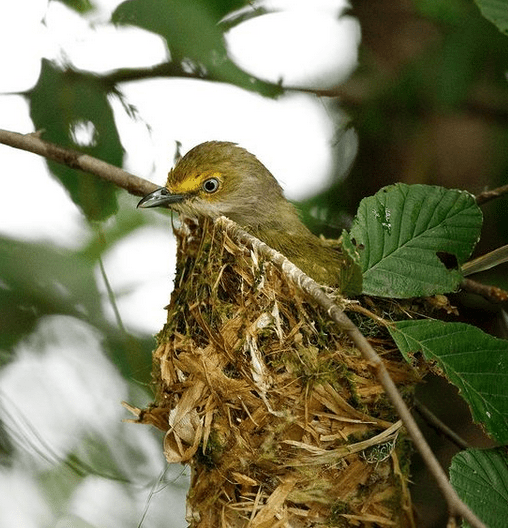
*scroll to see nest pics from last spring
In fact, you’re most likely to see them at eye level looking for a meal.They are usually found in wet areas such as along the shorelines of creeks, ponds, swamps and marshes. The dense scrub brush growing along banks of the creeks and swamps here at Croatan is a great example of their favored habitat.

These handsome birds call North Carolina home during the summer with a range that stretches from lower elevations of the Appalachian’s all the way to the coast. They’ll be here throughout mid October so you’ll have plenty of time to see them in the year ahead.
Photos by @sally_siko of @bestlife_birding on my mighty mirrorless monster, the @canonusa #R5
White eyed Vireo nesting information for NC

By: Sally Siko

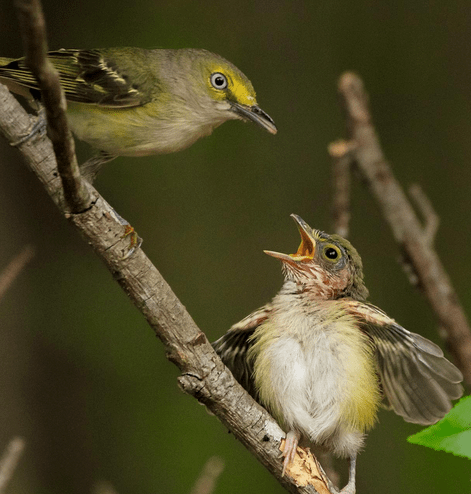
I always enjoy spending time with fledgling birds like this White-eyed Vireo when exploring the outdoors here in central NC.
It was so neat to spend a few minutes watching the little guy being fed by it’s parents. I first located the young one by hearing it’s chirps echoing in the trees as it was calling out for a meal.
After spotting him perched on a low branch, I sat very still on the ground on the ground to await the return of it’s parent.
Happily that did not take very long and I was rewarded with the opportunity to grab a few photos of the encounter!


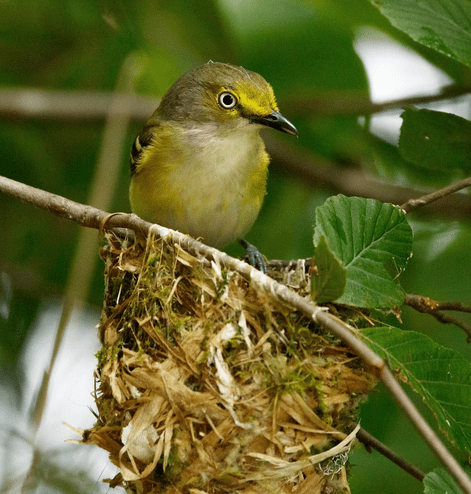
A White eyed Vireos nest is a marvel of the delicacy of bird brained engineering.
They collect soft strips of bark and grass which is woven into a sturdy hanging basket, fastened to a branch with spiderwebs. It’s actually quite deep relative to the size of its occupants and the mother bird can disappear into the triangular shaped cup simply by ducking her head down.


Incubation of the eggs takes around 15 days and the young will typically stay in the nest for 11 days before fledging. The work is not over for the parents though since the little ones will still be taken care of up to 20 days after fledging before becoming independent.
Interestingly, fledgeling male White-eyed Vireos learn their father’s song very early in life, and may begin mimicking his call as early as one month after leaving the nest.
Young White-eyed Vireos like this little one may even develop some elements of their songs by sampling the song tracks of their avian neighbors.
Pretty cool, huh?

Photos by @sally_siko of @bestlife_birding on my beloved full frame 50MP beast, the mighty @canonusa #5Ds

Spending time with nesting White eyed Vireos

It’s always neat to encounter White eyed Vireos when out looking for birds here in central NC.
A constant trail companion, their familiar songs calling out from unseen tangles of brush remind me that I’m never truly alone when walking in the woods.
As is the case with this pair of Vireos I photographed (with a zoom lens as not to disturb the parents) earlier this week, these birds are quite active during this time of year as they hunt for a six or eight legged meal to feed their growing families.


A White eyed Vireos nest is a marvel of the delicacy of bird brained engineering.
They collect soft strips of bark and grass which is woven into a sturdy hanging basket, fastened to a branch with spiderwebs. It’s actually quite deep relative to the size of its occupants and the mother bird can disappear into the triangular shaped cup simply by ducking her head down.


Incubation of the eggs takes around 15 days and the young will typically stay in the nest for 11 days before fledging. The work is not over for the parents though since the little ones will still be taken care of up to 20 days after fledging before becoming independent.
Interestingly, fledgeling male White-eyed Vireos learn their father’s song very early in life, and may begin mimicking his call as early as one month after leaving the nest. Young White-eyed Vireos may also develop some elements of their songs by sampling the song tracks of their avian neighbors.
Pretty cool, huh?

Photos by @sally_siko of @birdwatching_nc on the full frame beast of an SLR, the mighty @canonusa
#5Ds

A White eyed Vireo at Bynum Bridge in Pittsboro NC

This past weekend, my son and I took a quick bird scouting trip to the Old Bynum Bridge in Pittsboro, NC.
With the sun shining and the green leaves popping out on the trees, it felt like the first official week of spring has arrived now that the drab tones of winter are giving way to the vibrant colors of a warmer season.


One of the nicest birds we found down by the river was this White eyed Vireo. It was quite easy to find this bird as he kept calling out loudly from the brush down at the waters edge. These Vireos are also easy to ID with those one of a kind, light blue eyes. I’m not sure why they’re called “white eyed” although it could be the color of the sky reflecting in their eyes that gives them that slight azure hue.


White eyed Vireos are the only members of the Vireo family that prefer to forage and nest in the understory of forests and brushy areas. In fact, you’re most likely to see them at eye level looking for a meal.
They are usually found in wet areas such as along the shorelines of creeks, ponds, swamps and marshes. The dense scrub brush growing along banks of the Haw River is a great example of their favored habitat.

These handsome birds call North Carolina home during the summer with a range that stretches from lower elevations of the Appalachian’s all the way to the coast.
They’ll be here throughout mid October so you’ll have plenty of time to see them in the year ahead.

Photos by @sally_siko of @birdwatching_nc on the king of baaaadasssss camera’s @canonusa
#5Ds

A White eyed Vireo at Yates Mill Park- Raleigh, NC

This past Monday, I made a quick birding trip to Yates Mill Park in Raleigh NC to see what was flying around in one of my favorite spots along the wetlands trail.


Happily, one of the first birds I saw was this handsome White eyed Vireo!
I was sitting on one of the benches on the bridge making very quiet whistling noises and he flew in and landed about 4 ft away at the top of a bush.
I slowly raised the camera up to put a focus on him as he sat there and watched me. At the sound of the first shutter click, he cocked his head at me and flew in even closer, just a couple feet away or less!
I froze because he was now too close for me to take his photo so I just sat there and smiled.
We stared at one another for a minute and then he took off again and landed a bit further away in another bush. Still, he was watching me with those lovely pale eyes which allowed me to grab a few more portraits before he finally took off across the marsh.
So cool!


White eyed Vireos are typically spotted in open areas containing dense brushy patches near water which exact describes the habitat where I was sitting with this one. They are quite noisy and are best found by listening for their distinctive calls of “cheeeek-of-the-village” emanating from the bushes.

They’ll be heading out of North Carolina shortly to their wintering grounds in the southern US as well as Mexico & the Caribbean.
Get out and see them while you can soon because they won’t return to the Tarheel state until March!

Photos by @sally_siko of @birdwatching_nc on the mighty full frame DSLR, the @canonusa
#5Ds

A white eyed Video Encounter at Bass Lake Park in Holly Springs North Carolina

fter a week stuck behind a desk doing some editing work, I finally got a chance to take a quick trip to Bass Lake Park in Holly Springs NC yesterday morning.
Happily, it was worth getting outside because I found a sweet White eyed Vireo searching for insects next to the water.


As seen in the second photo below, White eyed Vireos are voracious eaters of six & eight legged prey.
They’re best found foraging for a meal in areas near water, but especially so in habitats that offer dense brushy stuff and dark thickets.


These energetic little guys spend most of the year here in central North Carolina before heading a little farther south during the coldest months.
Interestingly, this species favors mixed deciduous forest during the summer for breeding but prefers to hang out in coniferous forests and Holly stands during the winter.


Though White eyed Vireos prefers to stick to the shadows, they are quite inquisitive and will definitely come check you out if you pish at them. To find them, listen for their call of “chick-a-buurio-chick” coming from the lower areas of the woods and keep a sharp eye out for their bright eyes reflecting the sunlight through the leaves.

Photos by @sally_siko of @birdwatching_nc on the fabulous full frame SLR, the @canonusa
#5Ds

Fledglings at Bass lake Park in Holly Springs N.C.

View this post on Instagram

While birding at Bass Lake Park in Holly Springs N.C. recently, I spotted a couple adorable fledglings in the brush next to the water. The first is a young White-eyed Vireo (along with it’s parent) and the second is a sweet little Prothonotary Warbler with its parent nearby. I took these photos using my zoom lens at full 600 mm as not to disturb the little ones or their parents. It’s very important to respect the space of these birds at this crucial time as they are still learning how to assess predator behavior and understanding what dangers people may or may not pose to them. Plus, you definitely don’t want to stress out the parents as this may interfere with the feeding behavior of caring for their young. During this time of year, sightings of young birds are common and when folks find them on the ground they tend to get worried. The best thing to do if you find a fledgling is to leave it alone. While you may not see it’s parent in the area, chances are it’s nearby or at least on the way back to care for its young. In the unlikely scenario where the little bird is visibly injured then it may be a good idea to contact your local wildlife rehabilitator who specializes in caring for birds. A simple Google search of the wildlife rehabilitators in your city and state is a good place to start. Photos by @sally_siko of @birdwatching_nc on the @canonusa #5ds

A post shared by Bird Watching N.C. (@birdwatching_nc) on

A white eyed Vireo at Bass Lake Park, Holly Springs NC

View this post on Instagram

While birding at Bass Lake Park in Holly Springs last week, I spotted a White-eyed Vireo hiding in the brush next to the water. Although he was partially hidden in the leaves, it was a ray of sunlight reflecting off of his bright twinkling eyes which caught my attention. He sat there on his branch for several minutes studying me for as long as I watched him. This little guy was as relaxed as could be which felt like a unique kind of moment to share with a song bird. This species of Vireo lives in forests, thickets, and old overgrown fields, and along wooded waterways in the US east of the Great Plains, from Illinois to Central New England and all the way south down to Florida and eastern Mexico. They are most easily spotted moving from branch to branch feeding on insects that it finds among the low canopy foliage of trees and dense bushes. The White-eyed Vireo is a somewhat common sight in the summertime throughout the state of North Carolina. Generally speaking they will stick around here through early October before heading south for the winter to dine on the bugs found in warmer climates. Photo by @sally_siko of @birdwatching_nc #canon #5ds

A post shared by Bird Watching N.C. (@birdwatching_nc) on