Tag Archives: birding trips nc

Winter North Carolina birdwatching tours coming soon

Can you feel it?
The cool breeze seeping in under the still warm sun and crisp blue skies.
The leaves starting to lose those vibrant greens in the west, fading ever so gently into muted tones soon to blaze red & gold into brown.
Yes.
Autumn is here in the Carolinas and following on its heels, the most wonderful time of year…
Weird duck season!!!


Today we’re all concentrating on the fall migrational movements of Warblers and other songbirds but in my opinion, winter will bring my favorite feathered gems to North Carolina.
Redheads, American Wigeons, Green winged Teal, Blue winged Teal, Snow Geese, Tundra Swans, Canvasbacks, Eiders, Pintails, Northern Shovelers and more waiting to delight us once the weather turns cold.
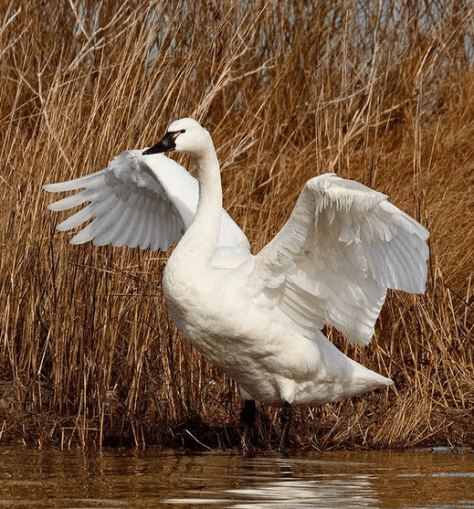
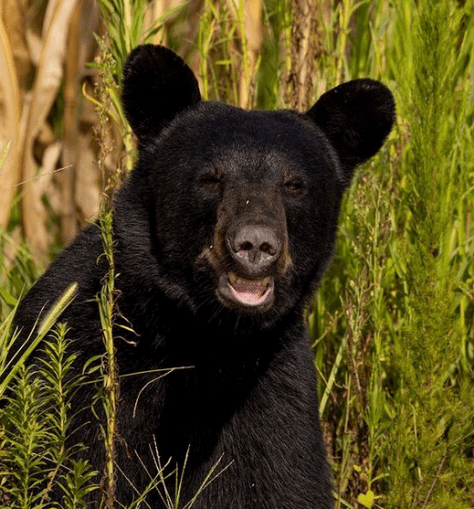

I’ve made the decision to spend as much time as I can this winter traveling to our coastal counties this winter to photograph and share as many duck species as I can from November to February.
Although I’ve got a pretty good idea of what I can expect to find out there, there’s always the potential to be surprised and delighted by something new floating out there in the water (or something furry hiding in a cornfield, lol!).

Wanna join me?
After all, birding & bird photography is better with friends!
Birders / Photographers of all skill levels are welcome and I’ll be sharing plenty of tips along the way.
Check out the link below for my winter tour schedule to book your date.

https://birdwatchingnc.com/birdwatching-n-c-trips-birding-in-north-carolina/


If you have any questions about the details of my trips shoot me an email anytime.
See ya out there!
-Sally

Photos by @sally_siko of @birdwatching_nc on the mighty @canonusa
#5ds
Spending time with a Yellow-throated Vireo at Brumley Nature Preserve

Every once in a while, I start seeing certain species of birds more often than others.
In this case I’ve noticed Yellow-throated Vireos seem to be flying around NC in greater numbers than in the past 5 years.
I spotted this one snacking on a caterpillar at the Brumley North Nature Preserve this past weekend.


While I don’t know the exact reason for the influx (it could just be luck-right place/right time scenario) I’m certainly happy to to have the opportunity to photograph them again without much effort.

Yellow-throated Vireos favor a different habitat preference to their more often seen relative, the White-eyed Vireo. They tend to shun pine barrens are best found foraging in the high canopy’s of the treetops in old growth deciduous forests and occasionally near wooded streams.
Interestingly, the Yellow-throated and White-throated Vireos share similar calls so finding one isn’t too difficult if you know what to listen for depending on if your in the woods vs. the field.


These cheerful little guys will stick around NC for just about a week or so before heading to their wintering grounds in Central and South America, south Florida and on through to the coast of Texas.
Get out and enjoy them while you can!

Photos by @sally_siko of @birdwatching_nc on the mighty mirrorless monster of a camera, the @canonusa
#R5

Enjoying the Great crested Flycatchers at the Pee Dee NWR

When walking around the large pond at the Pee Dee NWR, you’re likely to hear the loud call of the Great crested Flycatcher echoing out over the water.
These birds are a cheerful sight as they glide from branch to limb on the submerged dead trees on a never ending search for a six or eight legged snack.


My guests and I enjoyed watching this pair of Flycatchers inspecting a hole in a tree for a few minutes. The birds would duck into the cavity briefly and pop back out happily chomping down a mouthful of insects.
Every so often, the male would sing and fluff up his crest before taking off to scout out new spots to hunt.
Truly a beautiful little bird!


Great crested’s are the only species of Flycatcher to nest in tree cavities in NC. They don’t excavate their own holes, rather they nest in the cavities drilled out by woodpeckers.
They will even nest in boxes or bluebird houses which are placed higher than 8 ft from the ground.

You can find Great crested Flycatchers in all 100 of North Carolina although they’re somewhat more common in the Piedmont and eastern coastal regions of the state.
Look (and listen!) for them in pine and oak forests as well as near ponds, swamps and marshes.
They’ll be here until September so you’ve still got plenty of time to enjoy them before they migrate south for the winter ahead.

Photos by @sally_siko of @birdwatching_nc on the full frame beast of an SLR, the mighty @canonusa
#5Ds

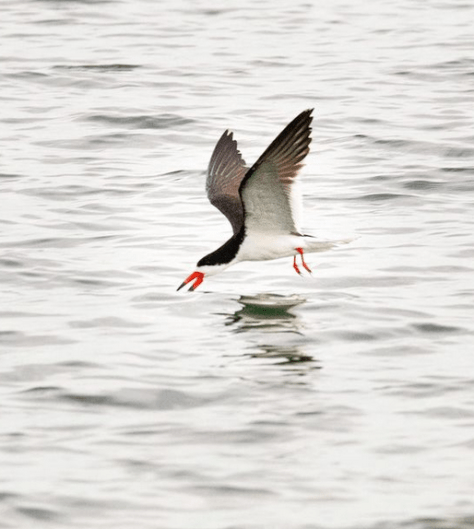
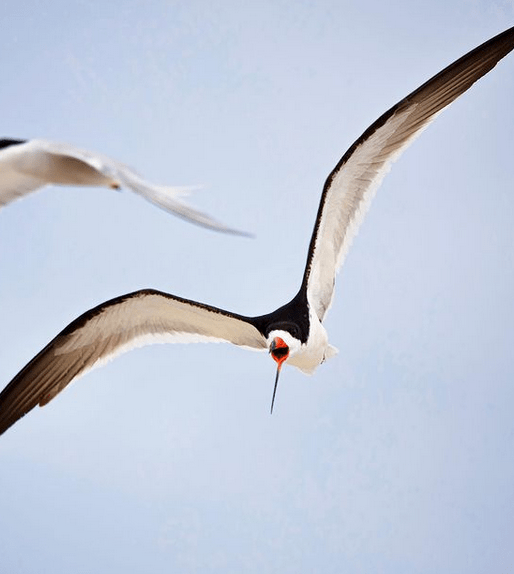
Spending time with Black Skimmers on Wrightsville Beach N.C.

Last month, I had the opportunity to visit a nesting colony of Black Skimmers on Wrightsville Beach NC.
It was so cool to be able to spend time with these interesting birds as they went about their business of raising their families on the beach.
I really like the look of the Skimmers.
With that bold black and white plumage, they are quite a handsome species indeed.


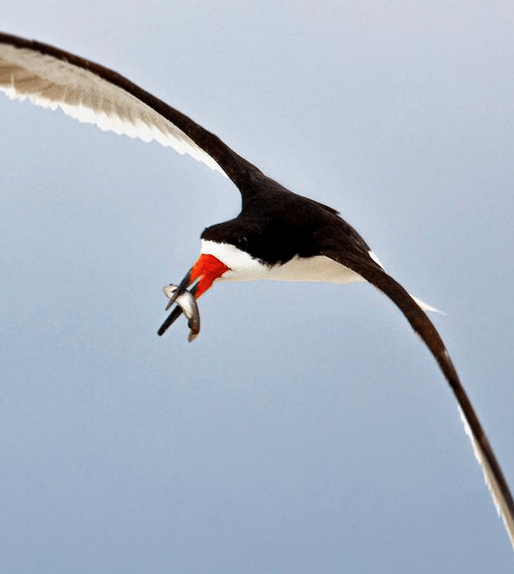
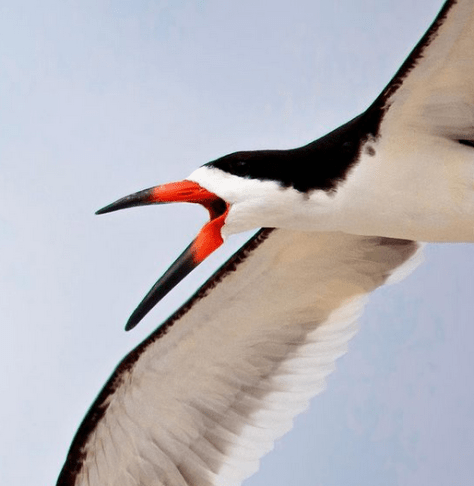
Nicknamed the ‘Toucan of the sea, the most striking feature of the Black Skimmer is it’s red-and-black bill.
As you can see here, they’ve got a lower mandible that juts out farther than does the upper.
When feeding, the Skimmer flies low over water with its beak open and lower mandible partially submerged.
When the lower part of the bill touches prey, such as a small fish, the bill’s upper mandible snaps down like a mousetrap, securing the bird’s meal.


Although you can find them soaring above the shorelines of most of our coastal beaches, Black Skimmers are most often spotted inland feeding in our inlets, estuaries and other slow moving bodies of water near the Atlantic.
Happily, Black Skimmers are a year round resident of North Carolina but they do appear to migrate locally to the southern coast of the Tarheel state during the cooler winter months.

Photos by @sally_siko of @birdwatching_nc on the full frame beast of an SLR, the mighty @canonusa
#5Ds

Birding at the Art Park: The Northern Cardinal

When bird watching in NC, one of the most instantly recognizable species is the male Northern Cardinal.
A familiar sight both in our yards and in the woods, these vibrantly colored birds are found in all 100 counties across the Tarheel State.
I spotted this handsome fellow at the NC Museum of Art Park yesterday morning hiding on a shady bough.


As the end of the nesting season draws near, the Cardinals will start to molt out their feathers which will be replaced by bright new plumage. Some of them even lose all the feathers on their head all at once! This one appears to have started the process as he’s looking a little rough around the edges.


The Cardinal’s signature crimson red colored feathers are a product of the birds diet of plants, fruits and seeds rich in carotenoids.
Although there are plenty of options for them to snack on in the wild, you can grow plants right in your own backyard to help your local Cardinals keep their bright color.
These guys love fruit like raspberries, blackberries and strawberries as these fruits are packed with the carotenoids the birds need. That being said, if you really want to impress your flock of Cardinals, plant a a Dogwood as those red berries produced by this flowering tree are by far and away their favorite backyard treat.

Photos by @sally_siko of @birdwatching_nc on the full frame beast of an SLR, the mighty @canonusa
#5Ds

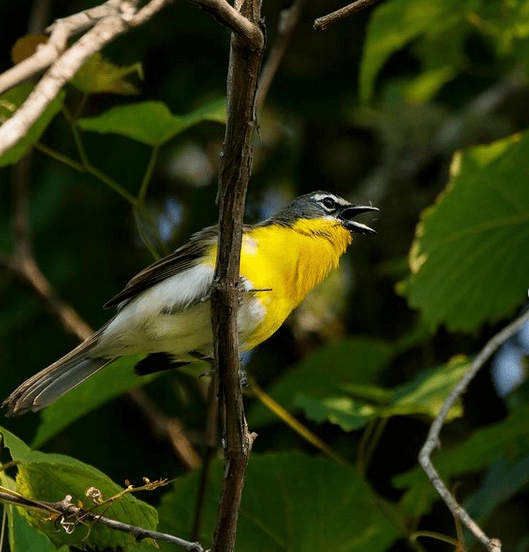
Birding at Brumley Nature Preserve: A Yellow breasted Chat

By: Sally Siko

While birding at the Brumley Nature Preserve in Durham NC, I heard a loud, familiar call coming from above me in the trees. Scanning my eyes through the leaves, a bright patch of yellow caught my eye as I hurriedly lifted my lens to get a better look.
There, high up in the branches was this handsome Yellow breasted Chat!
Since he never flew down any lower I was only able to catch a few somewhat decent photos of him from below (would have rather captured an eye-level shot) but gosh I was happy to see him.


Measuring up to 7.5 inches in length, Yellow breasted Chats are the largest species of wood-warbler in the United States.
Other than those bright colors and similar habitat preferences, they share little in common with other warbler species.
The most noticeable difference are their songs which are best described as a weird mix of chattering clucks, croaks, rattles, squawks, mews, gurgles and popping noises.
They even make a call which sounds to me like the first note of a Bobwhite whistle.

Another key difference is their bill which is proportionally much thicker than that of other warblers. It sort of reminds me of a Tanager bill.
Like Tanagers, Yellow breasted Chats are fond of eating bees, wasps and other insects as well as berries and other wild fruits when insects are scarce.


The key to finding Yellow breasted Chats is to listen for them. They are quite loud and are relatively easy to locate by their calls.
Look for them where the woods meet the fields, in clear cut open areas containing stands of scrubby low brush or young saplings, especially in places where there is a water source available.
They’ll spend the summer in NC, sticking around until late September so you’ve still got a few months to enjoy them before the season is done.

Photos by @sally_siko of @birdwatching_nc on the full frame beast of an SLR, the mighty @canonusa
#5Ds

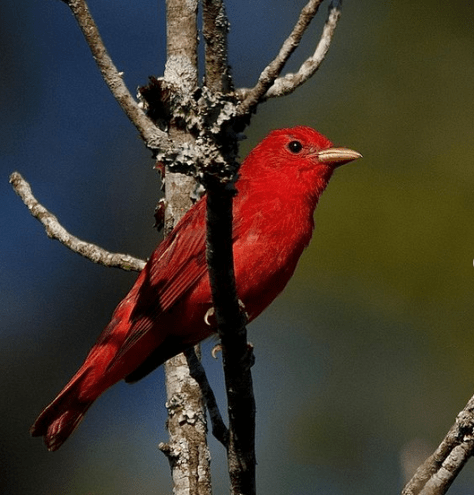
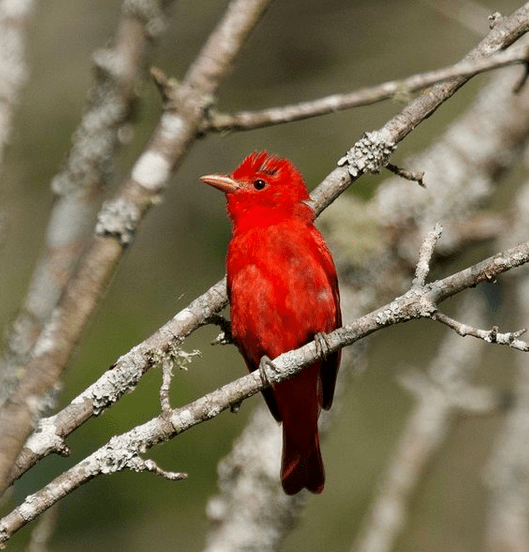
Summer Tanagers at the Pee Dee NWR

One can hardly hike more than a few minutes in the woods here in central NC without hearing the cheerful call of the Summer Tanager.
This was the case when I spotted this male singing in the trees at the Pee Dee NWR in Wadesboro NC last week. He was easy to find with that bold red plumage, especially when he landed on the bare branches of a dead tree near the shoreline of the lake.
Such a gorgeous bird!

Did you know that the Summer Tanager is the only entirely red colored bird found in the United States? Northern Cardinals and Scarlet Tanagers come close however both of those species also have black feathers on their bodies.
All three species get their bold red hues from carotenoid compounds which produce the red (and sometimes yellow) colors seen in the birds feathers. These are acquired through their diets (mainly through fruit), and are then processed in the body into pigments that are deposited in the growing feathers.

Summer Tanagers are generally spring and summertime residents of North Carolina.
They arrive in April and hang out until September before migrating south to Mexico, Central and South America. That being said, there are small but growing numbers of Summer Tanagers that stick around for the entire winter in the eastern part of the state provided that they have a reliable food source available to them via a feeder.
Pretty cool huh?
🙂

Oh btw, I’ve posted new birdwatching tours to the Pee Dee NWR (where I photographed this Summer Tanager) here on this website.
Wanna join me?
Check out the link below for booking details.

Photos by @sally_siko of @birdwatching_nc on the full frame beast of an SLR, the mighty @canonusa
#5Ds

The Horned Larks are back at Mid Pines Rd

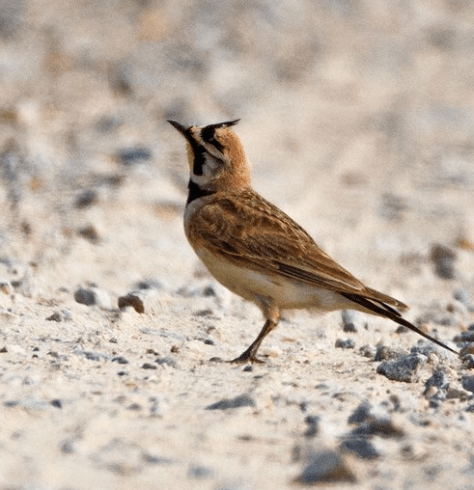
Here’s a bird I was delighted to see at Mid Pines Rd. in Raleigh, a Horned Lark!
Although my photos weren’t the best, it was really cool to get a good look at one of these interesting birds from a relatively close distance. Plus it was on the gravel road instead of hiding in the grass which made it even better lol!


Horned Larks are a year round resident of North Carolina with local population fluctuations occurring with the changing seasons. They are are especially common in the eastern part of the state during the winter months.
As is the case with the NC State Ag Campus here at Mid Pines Rd, these guys prefer short grass open habitats and also can be seen in other agricultural areas hunting for a meal in plowed farm fields or places where the crops haven’t sprung up yet in the sandy soil.


Although I haven’t seen very many over the years, these little birds are pretty easy to ID in the field with those two namesake feathered black tufts at the top of their heads. They’ve also got a sweet melodic tinkling song which carries a bit on the wind. This is incredibly helpful when trying to locate a single bird in the brown grass or dirt from several yards away as Horned Larks tend to blend in quite well with their surroundings (especially when viewing from the back side).

I’ll be leading another tour at Mid Pines Rd & Yates Mill Park again soon. I hope these neat little birds are still around so I can share them with my guests!

Photos by @sally_siko of @birdwatching_nc on the full frame beast of an SLR, the mighty @canonusa
#5Ds

American Oystercatchers on Wrightsville Beach

One of my favorite birds to see when visiting the coast are the American Oystercatchers.
With those bright orange eyes and red bill set off by that gorgeous brown, black and white plumage they’re one of the sharpest looking birds on the beach.


I was happy to see a couple of chicks zipping around the dunes and was pleased when one of the little ones stopped running long enough for me to grab a quick portrait.
Isn’t he cute?
🙂

American Oystercatchers are a year round resident of North Carolina. During the summer months they are found nesting in our dunes.
Although the breeding birds are a familiar sight along our beaches (like this one on Wrightsville) they’re most often spotted hunting for a meal in coastal areas where oysters are present such as on sandbars, tidal mudflats and along the rocky areas near jetty’s.

Oystercatchers feed almost exclusively on shellfish and other marine invertebrates including mussels and clams of many varieties, limpets, sea urchins, starfish, crabs, worms and of course oysters (shocking, yes I know haha!).
One of the most striking feature of these handsome birds is that bright red bill.
More than just a pretty facial feature, it’s actually the key tool they use for getting a meal.
Wading through shallow waters over oyster beds, they’ll locate the oysters which are partially open. Once they spot one, they’ll stab at it, inserting their long knife-like bills into a mussels partially open shell, quickly severing the powerful adductor muscles before the shells can close.
 Then in proper ‘raw bar fashion, down the hatch the soft parts go.
Makes me wonder if they ever have a hankering for a beer to wash it all down with lol!

Photos by @sally_siko of @birdwatching_nc on the full frame beast of an SLR, the mighty @canonusa
#5Ds

Anhinga encounter at Airlie Gardens

Here’s a bird I was really happy to find during a recent birding trip to southeastern NC, an Anhinga!
In fact I got lucky and was able to spot two of them (an immature and an adult) on the ponds at Airlie Gardens in Wilmington.
Although I’ve seen this species before, these are the first photos I’ve ever captured of this large, prehistoric looking bird.


Anhingas are actually a species that is on the increase here in the Tarheel State. They favor habitats containing freshwater with cypress trees and are most often spotted hunting for a meal in swamps, ponds and lakes in the coastal plain and in the eastern Piedmont regions.


As you may have guessed, Anhingas eat a wide range of aquatic creatures such as fish, crayfish and frogs. They often dive underwater to catch their prey. Using their sharp bills, they impale their prey by piercing it straight through.
Interestingly they’ve evolved with some unique ways to hunt underwater more efficiently.
For one, they lack the water proofing oils found in duck species. Since (surprisingly) they’re not the strongest swimmers, they become waterlogged once their feathers become saturated. This added weight allows the Anhinga to dive deeper than it could if it was waterproof.
Another cool feature of the Anhinga is that they do not have nostrils. This adaptation means they’ve got no worries about accidentally breathing in water while hunting below the surface.
It’s neat that a bird that looks like it belongs in the Jurassic Period would actually be the one species which is holding the latest in cutting edge freshwater hunting physiology, lol!

Photos by @sally_siko of @birdwatching_nc on the full frame beast of an SLR, the mighty @canonusa
#5Ds