By: Sally Siko
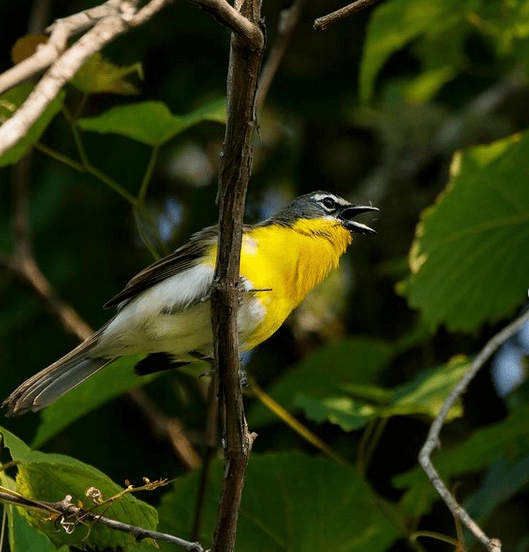
While birding at the Brumley Nature Preserve in Durham NC, I heard a loud, familiar call coming from above me in the trees. Scanning my eyes through the leaves, a bright patch of yellow caught my eye as I hurriedly lifted my lens to get a better look.
There, high up in the branches was this handsome Yellow breasted Chat!
Since he never flew down any lower I was only able to catch a few somewhat decent photos of him from below (would have rather captured an eye-level shot) but gosh I was happy to see him.
Measuring up to 7.5 inches in length, Yellow breasted Chats are the largest species of wood-warbler in the United States.
Other than those bright colors and similar habitat preferences, they share little in common with other warbler species.
The most noticeable difference are their songs which are best described as a weird mix of chattering clucks, croaks, rattles, squawks, mews, gurgles and popping noises.
They even make a call which sounds to me like the first note of a Bobwhite whistle.
Another key difference is their bill which is proportionally much thicker than that of other warblers. It sort of reminds me of a Tanager bill.
Like Tanagers, Yellow breasted Chats are fond of eating bees, wasps and other insects as well as berries and other wild fruits when insects are scarce.
The key to finding Yellow breasted Chats is to listen for them. They are quite loud and are relatively easy to locate by their calls.
Look for them where the woods meet the fields, in clear cut open areas containing stands of scrubby low brush or young saplings, especially in places where there is a water source available.
They’ll spend the summer in NC, sticking around until late September so you’ve still got a few months to enjoy them before the season is done.
Photos by @sally_siko of @birdwatching_nc on the full frame beast of an SLR, the mighty @canonusa
#5Ds