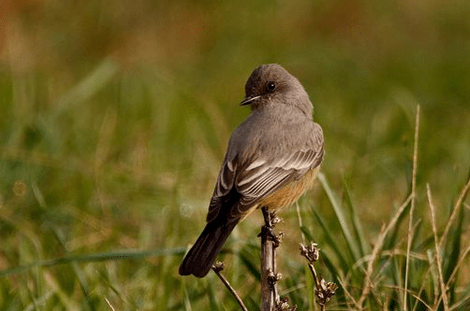
After missing out last weekend, I finally got this morning to see the Say’s Phoebe that’s been hanging out at the Guilford County Farm in Gibsonville, NC. Rarely seen on the east coast of the US, the Say’s Phoebe’s normal range extends from Alaska, throughout the western United States and down into Mexico. The fact that this bird somehow ended up in central North Carolina is pretty cool!
This bird looks similar to the Eastern Phoebe except that it has a grey breast and a salmon colored belly. It even behaves in a similar way with tail flicking which I thought was pretty cute 🙂 Although I hadn’t seen one until today, I know that Phoebes prefer to hunt for insects at the edges of open grassy areas so when I set out to search for it I had a pretty good idea of where it would likely be. It took about two hours of searching when the bird finally showed up in the corner of a field near one of the farm sheds. Success!
Coincidentally, there was another large group of birders on the farm that day. While we didn’t interact with each other, I assumed they were searching for this bird too. I quickly grabbed a few photos of the Say’s and then jogged up the fence line to see if there was anyone still hanging out from that group who’d like to see this bird. Unfortunately, all of the birders had left the farm except for one guy (Hi Keith!) so he was the only one who got to view the Say’s with me. Oh well, I tried. Lol, even when I’m not leading a tour I can’t stop myself from sharing my happy bird-nerd moments with others!
This particular bird has been hanging out at the farm for around 3 weeks so it’s likely that it’ll still be there for a few more days. It seems to prefer that field along northeastern corner of the bob wire fence line.
By the way, the Guilford County Farm park is public property and there is a public parking lot on-site so no worries about hiking around the grounds. If you’d like to find it too I’ve included a Google map showing the exact spot where I found it below.
One of the nice things about birding is that there’s always the potential to be surprised and delighted by unexpected finds in the field. In this case, a Cattle Egret has shown up in the Raleigh NC area and seems to have made itself right at home with a herd of cows on Mid Pines Rd.
At first, the cow didn’t seem to mind its feathered companion but when the bovine stood up, the Egret hopped off and then proceeded to chase the hapless cow around the pasture. For its part, the cow was unamused by the birds antics lol! It lowered its head and snorted at the Egret every time it approached leaving the bird to forage in grass for itself.
Cattle Egrets are a summertime resident of the Tarheel State but are a rare sight during the winter and even more so here in central North Carolina. They breed in colonies on our barrier islands and inland in our southeastern counties on lakes and river that are in close proximity to agricultural fields. As their name suggests they may be found feeding in the pastures looking for insects kicked up by herds of cattle. Look for them in North Carolina’s southeastern coastal counties from mid March- early November or take a drive on Mid Pines Rd in Raleigh this weekend 🙂
The neatest thing about birding is that ya never quite know for sure what you’re going to see when you step outside. Sure, we’ve got our goals and general expectations on hand but each time we head out there is an opportunity to to be surprised and delighted with an unexpected find. Case in point, this Lark Sparrow that I spotted while leading a trip to the Pea Island NWR this past Sunday.
Up until that point, tbh the birding was less then stellar that day lol. There had been a remarkable lack of bird activity going on so when I first put this bird into focus on my lens it was pretty exciting! The reason why is because the Lark Sparrow’s range stretches from primarily the Great Plains and west to the California coast. Year-round populations also occur in Texas and northern Mexico. That being said a very, very small population of Lark Sparrows spend the summer right here in North Carolina too! Usually those birds are found in isolated spots the Sandhill region of the central part of the state so it was incredibly cool to find one here in the OBX at the beginning of migration.
When Lark Sparrows do show up in the eastern counties of NC during the autumn months, they prefer to forage in areas of wide sandy-scrub patches. The dry dunes and field habitats here on Pea Island are just perfect for them. Unfortunately these beauties won’t be here for much longer as most will head south for the winter in a week or two but if you missed them this year, the Lark Sparrows will return to the Tarheel state next April.
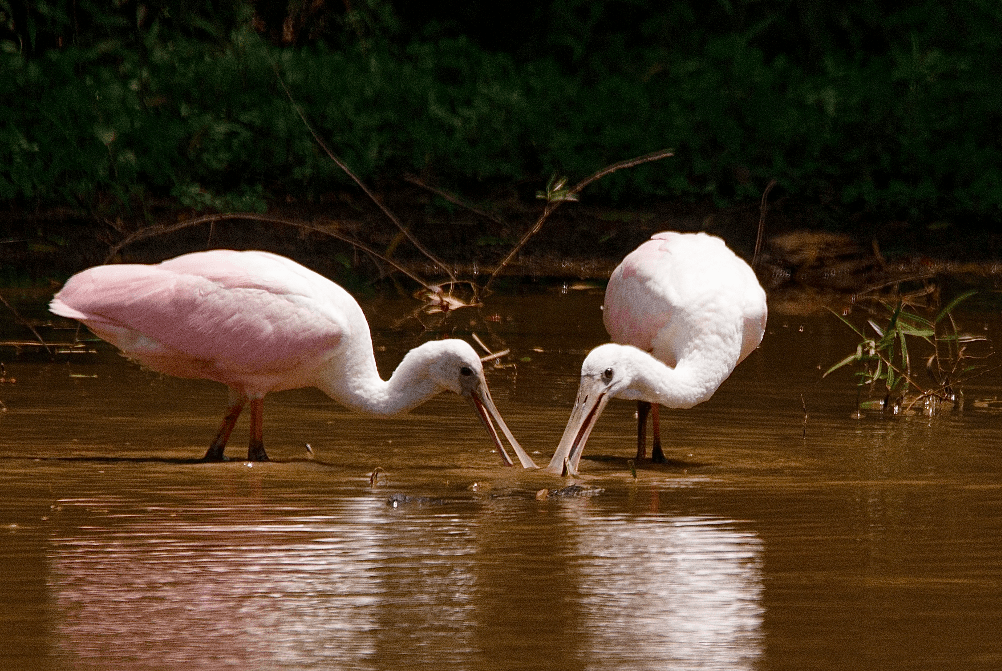
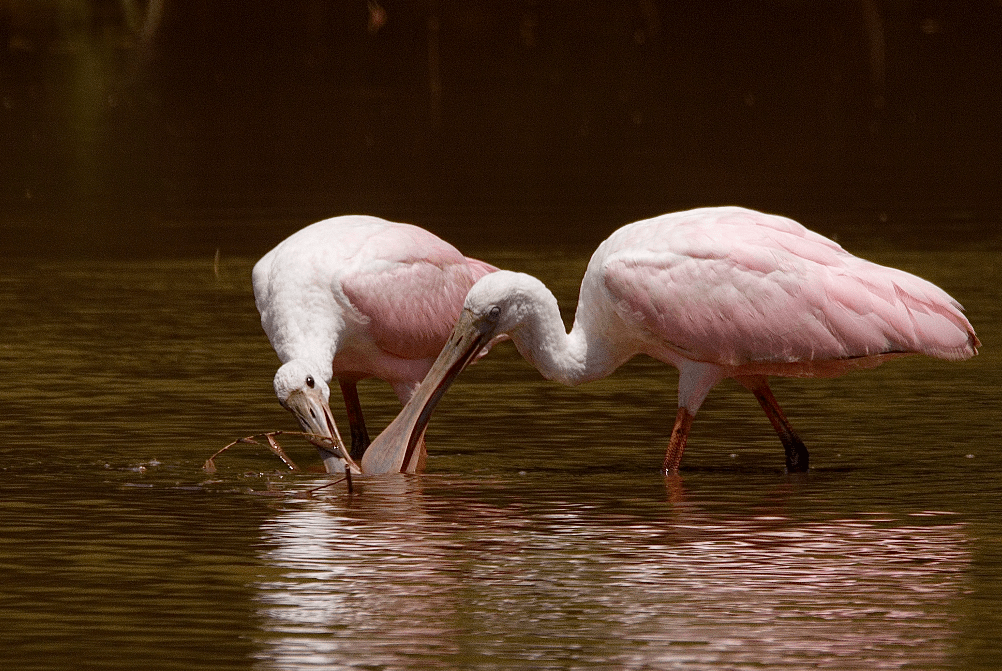
Yesterday I received a rare bird notification from @eBird that a pair of Roseate Spoonbills had been spotted at Lake Lynn in Raleigh NC so I decided to go see if I could get a look at them with my friend Corie @calatta We met up an hour later in the southern parking lot and walked to the north end of the lake where we were happy to find these beautiful birds hunting for a snack in the shallows with a Little Blue Heron Nice to get a win so easily!
Roseate Spoonbills are normally found in southern Florida and along the coast of Texas during the summer which is why it was so unusual to find these two at Lake Lynn. That being said, sightings of Spoonbills here in North Carolina have been on the increase in recent years though most of those have occurred in our southern coastal regions.
These lovely birds are best spotted in marshy areas foraging for a meal in the water or mudflats. Sweeping their namesake spoon-shaped bill side to side in the shallow water, the Spoonbills mouth is partially open as their bill probes into the mud. When they stir up a fish or invertebrate, they’ll clamp that bill shut to capture their prey. Their diet mainly consists of minnows, but they’ll also eat shrimp, crayfish, crabs, aquatic insects, mollusks, and slugs. Spoonbills will also snack on plants including the roots and stems of sedges.
I have no idea how long these two will stick around the Triangle for so if you can get out within the next day or two you might be able to find them as well. For reference, I’ve included a Google Map pin drop showing the exact location of these birds at the north end of Lake Lynn (as of yesterday & today) to the end of this post. Hope you are able to see them too! Happy birding! -Sally
Yesterday, I was fortunate to be able to go check out a Varied Thrush at a private residence in Cary North Carolina. When I arrived at the property, the cheerful sign hung on the mailbox was proof that I was at the right place.
The homeowner Tony, greeted me warmly and said that this bird had been foraging in his backyard for 31 days straight. As it turns out, he’s is a bird loving photographer too (follow him @thewitt68 ) so it was quite fortunate that this little Thrush landed in his yard! Tony was such a gracious host and couldn’t have been more accommodating. He even set up signs and a map of his yard directing people where to find the bird as well as providing a guest book for visitors to sign. Judging by the number of pages that were filled with signatures, this place has been really hopping throughout the past month. This little bird has become quite the celebrity around here!
With so many people stopping by to see it, Tony told me that his neighbors have even adjusted their daily yard work schedules as not to disturb the bird in the morning when it is most active. Truly this Varied Thrush has been embraced by the neighborhood where it’s apparently decided to spend the winter. What thoughtful people 🙂
Now, why the fuss over a single bird you may ask? Well, this attractive species of Thrush is decidedly a west coast dweller. They nest in Alaska, western Canada and into the Pacific Northwest. When autumn arrives, Alaska breeders will typically migrate south to spend the winter in southern British Columbia and even all the way down to California. The fact that this single Varied Thrush has shown up in a backyard here in central North Carolina is pretty darn cool.
They look sort of like an American Robin but chunkier with a bolder cut to its plumage pattern. The males have slate gray feathers on their backs and a dark band of feathers on it’s orange breast. Females have similar plumage but boast a muted color palette with brownish ear coverts and a dull grey breast band. Truly a striking looking bird in my book.
Interestingly, although they do forage for worms and grubs in the leaf litter as other species of Thrush are known for, the Varied Thrush’s diet changes during the wintertime to include seeds, berries & acorns. Watching this bird rooting around for a bite to eat under the homeowners bird feeders, it was the first time I’d even seen a Thrush species snacking on sunflower chips. Neat to see and learn something new on the same day 🙂
Special thanks to Tony in Cary, North Carolina for his hospitality and to Sheri Thompson too!
View of a wide open field at the Pungo Unit at the Pocosin Lakes NWRPungo LakeLake Mattamuskeet
Yesterday I headed out to go birding on the Pungo Unit at the Pocosin Lakes NWR and Lake Mattamuskeet. Originally I’d intended to see if I could find another Painted Bunting but that was not to be. Yet as it goes with birding, often disappointing losses actually turn into interesting opportunities to see new birds that one never expected to find. Well, that’s exactly what happened 4 times yesterday!
GREATER YELLOWLEGS
Greater Yellowlegs at Pungo Lake
The first unexpected encounter was with a Greater Yellowlegs that I found looking for food in what may be (generously lol) described as a big puddle at the Pungo Unit. Although they are known to spend the winter here, these handsome birds normally aren’t found in NC during the summer.
A Greater Yellowlegs in breeding plumage at the Pocosin Lakes NWR , July 2020
As seen in this photograph, during the breeding season, the Greater Yellowlegs sports plumage patterns of dense, nearly black lines speckled on their pale grey breast and necks. It’s quite a change from what we normally see of them in the wintertime which is a muted brown buff color.
Check out the map below for the location of where I found this bird.
BOBOLINK
Male Bobolink at Lake Mattamuskeet (molting plumage)
The second unexpected bird I found was a male Bobolink at Lake Landing on Lake Mattamuskeet. This was the place I’d expected to find a Painted Bunting and I was so focused on listening for their familiar call that I nearly missed the Bobolink. I first heard him calling out from the talk rushes sticking up from the mud flats of the drained pond. Initially I thought it was a Red-winged Blackbird call so I ignored it. After hearing it call out over and over again, I focused my camera on it because the calls began to sound different than usual to me. It was pretty far away but as soon as I saw that pale patch of feathers on his nape, I knew that this was no blackbird! I tried my best to get some clear photos but the bird remained far away at the limits of my focal ranges, thus the photos I took aren’t the prettiest. Still, I’m very happy to have documented the moments I first saw a Bobolink in the summertime at Lake Mattamuskeet!
A male Bobolink flying at Lake Landing on Lake Mattamuskeet
The Bobolinks northern breeding range extends from Maine to Washington State which is why it seems unusual to see one on the middle of July. That being said, their spring and fall migration does bring them down here to NC. Perhaps this one arrived in March and is just getting a head start on the autumn journey ahead by sticking around here for the summer.
Check out the map below for the location of where I found this bird.
TUNDRA SWAN
A lone Tundra Swan at the Pungo Unit in July
The third surprise bird was this gorgeous Tundra Swan at the Pungo Unit. I found the bird swimming around in a flooded out field with a flock of Canada Geese. I have had the pleasure of witnessing the great flocks of Tundra Swans during their winter migration here at the Pungo Unit in the past. It’s pretty weird to think that just six months ago there may have been more than 300k Swans filling the waters and fields here but now, there’s just this one.
Tundra Swan at the Pungo Unit July 2020
I met up with another N.C. wildlife photographer, Robert Mullen while I was out on this day who photographs birds here several times a week all year round. He indicated that the belief of the wildlife officials is that this bird may have been injured over the winter and was unable to migrate this past spring. I felt bad for this elegant one, all alone in the refuge. But, if he can survive the next few months, he’ll have plenty of company to spend time with this winter as the rest of the flock makes the southward journey from the Arctic to the Pungo Unit.
Check out the map below for the location of where I found this bird.
MAGNOLIA WARBLER
Last but definitely not least, I got very lucky when I spotted a female Magnolia Warbler while driving on Canal D Rd. in the Pungo Unit. I was headed out to the soybean fields to look for bears in the late afternoon when a flash of small yellowish bird flew in front of my truck and into a tree next to the dirt road.
A single female Magnolia Warbler at the Pungo Unit in July
I pulled over, grabbed my camera and got out of the truck to see if I could find and ID the bird before it disappeared deeper into the woods. Let me tell you, this was a difficult little bird to photograph! The sun was very bright and the shadows very dark when peering into the viewfinder of my camera. I’d lower my lens to look up at the tree to try and spot the movements of this tiny bird, locate it, then bring the camera back up to my face to try and snap a photo. The problem was that Magnolia Warblers are fast movers! As soon as I’d get a clear shot (and good exposure) it would move behind a leaf. I must have taken 15 photos and still only came up with two, half blurry shots lol! At least they are good enough for ID purposes so I’m chalking that experience up as a win in my book 😉
Magnolia Warbler (female)
Their typical breeding range extends from the mountains of WV, western VA, central PA, NY, MN, MI and up into New England and Canada. Although it is uncommon, Magnolia Warblers also breed in the mountains of northwestern NC. That’s why I was surprised to see this sweet female in July. I’m hoping that she will find a mate (or at least some friends) when the rest of the Magnolia Warblers make their way down here in September during fall migration.
Check out the map below for the location of where I found this bird.
Though I never found the Painted Bunting I’d planned for, I’m very happy with how the trip went yesterday. Like searching for gold, then coming up empty only to find diamonds instead, it’s days like this that renew my love for the adventure of birding.
Oh by the way, I did find some other birds yesterday at the Pungo Unit and Lake Mattamuskeet that aren’t rare but still are pretty cool too! Check out the photos below!
I set out today to find a rare White-fronted Goose that had been recently reported in the Mid Pines Rd. area of Raleigh North Carolina. Driving along the gravel road , I searched the fields and ponds. But, to no avail. This Goose was nowhere to be found.
Not finding anything interesting, I turned my truck around. Maybe I should check out nearby Yates Mill Park to see if the Goose might turn up there. As I made my way back down the road, a raptor perched on a far away tree caught my eye. I pulled over, grabbed my camera, and hopped out of my truck.
The skies were still pretty dark at this time. It was very difficult to focus my lens on the bird in these lighting conditions. I snapped off three shots. I reviewed the first two in camera and was disappointed with the quality of the images. They were so dark and grainy and absolutely useless for ID purposes.
Feeling deflated, I did not even bother looking at the third photo assuming that it was garbage too. In fact, I almost deleted the photos off of my camera right there and then. Left thumb planted on the trashcan button, for some reason, I hesitated. Something inside me said “look at these photos later”. So, I kept the RAWs anyway.
Standing there in the cold field, I debated weather or not to keep trying to get a better shot of this mystery raptor but ended up deciding to move on with my search for the White-fronted Goose. After all, this bird was really far away and the lighting was not looking like it was going to improve with all of the clouds moving in. Besides, my first thought was that this was likely a Red-Tailed Hawk and I’d have plenty of other (and better) photo opportunities to see one later.
So, off to Yates Mill Park I went. I did not give this encounter a second thought. Especially after how my birding at Yates Mill Park went. Let’s just say that I was not dissappointed. More on that later, stay tuned!
When I got home, I uploaded the photos onto my Mac. I could not believe my eyes! Yes, the first two photos of the mystery raptor were indeed absolute hot digital garbage but that third image… this third shot did not show a Red-tailed Hawk.
No.
My one, the only good shot of the Peregrine Falcon I spotted this morning at Mid Pines Rd.
It was a freak’n Peregrine Falcon!!!
This is a particularly nice find. You see, up until the 1950’s, Peregrines nested regularly here in North Carolina. Then, they were nearly completely wiped out, almost to the point of extinction. Their rapid disappearance from the eastern U.S., (as well as their decline in areas of the western U.S.) were caused by man-made environmental contaminants, including the pesticide known as DDT.
These pesticides got into the water and were absorbed by insects. Small birds ate the poisoned insects, and became contaminated themselves. Peregrines ate the contaminated small birds, and by now the multiplier effect of the pesticides in the food chain caused concentrations high enough to kill many birds directly. Worse yet, the pesticides interfered with calcification of eggshells, resulting in thin eggshells which were crushed as the parents sat on them during incubation.
In 1970, the U.S. Fish and Wildlife Service listed the Peregrine falcon as an endangered species. Recognizing the effect of DDT, the E.P.A. banned this pesticide from use in the United States back in 1972. Attempts at restoring the peregrine falcon began in 1974 with the first release of captive bred falcons.
The N. C. Wildlife Resources Commission began releases in 1984. Eighty juvenile peregrines had been released in the state by 1991. An additional 12 birds were released in 1996 and 1997 to increase the population in the Southern Appalachian Mountains.
Although the U.S. Fish and Wildlife Service removed the peregrine from the Federal Endangered Species list in 1999, it remains protected under the N.C. Endangered Species law and at the federal level by the Migratory Bird Treaty Act.
Although, the survival of peregrines in N.C. still remains tenuous due to a low rate of successful nests, the species does appear to be recovering (slowly) here in the Tar Heel state through the efforts of the North Carolina Wildlife Resources Commission breeding and nest monitoring programs.
This bird is a lifer for me as I have never photographed a Peregrine in the wild before. I’m absolutely thrilled and am honestly wishing that I could leave right now to go back out to this birding spot to get another crack at photographing this bird. Unfortunately, my family has other plans for the rest of my day.
But, that doesn’t mean that you cant try instead!
Ok, here are the details of where I saw this bird along Mid Pines Rd. Below is the Google maps link to get to the general area…
Here is a screen shot of the exact location where the Peregrine was sighted. I spotted him in the treeline that lines the field to the north-east of the dog-leg.
Hope that you get a chance to see and photograph this impressive bird too!
Happy Birding!
-Sally
References: Phil Spivey, Allen Boynton. Updated by Chris Kelly, NCWRC Johnsgard, Paul A. Hawks, Eagles and Falcons of North America (Washington, D.C.: Smithsonian Institution Press, 1991).Ratcliffe, Derek A. The Peregrine Falcon (Vermillion, SD: Buteo Books, 1980).Scott, Shirley L., ed. Field Guide to the Birds of North America (Washington, D.C.: The National Geographic Society, 1987).Terres, John K. The Audubon Society Encyclopedia of North American Birds (New York, N.Y.: Wings Books, 1980
Spotted a small group of Sandhill Cranes preening among a flock of Tundra Swans yesterday morning at Pungo Lake in the Pocosin Lakes NWR. I’ve never seen one in the wild before so it was thrilling to finally have a chance to photograph them. So awesome to get another lifer!
Sandhill Cranes Pungo Lake, N.C.
Scientists believe that ten million years ago, birds similar to these were found to be structurally the same as modern Sandhill Cranes. Today, these beautiful birds are found throughout in North America. Their range extends from Mexico, through the United States and as far north as Siberia. Despite the widespread occurrence of the species in the Western Hemisphere, they are not commonly found here in North Carolina. It was wonderful to add one more “rare” bird species to my eBird list as the year draws to a close 🙂
Sandhill Cranes are omnivorous and will dine on items such as lizards, small rodents, frogs and insects, as well as vegetables, such as bulbs, roots, grains and seeds. The ones I photographed here seemed to split up their time between preening and foraging for food in the mudflats along the shoreline.
Six Sandhill Cranes preening at Pungo Lake, N.C.
This small flock of birds may have hit the jackpot by choosing to spend a few weeks this winter here at Pungo Lake. In addition to hosting a variety of small lizards and rodents on site, the lake is surrounded on all sides by wide open fields of cut corn stalks, with plenty places available for the Cranes to feed on spilt grain on acres of vast agricultural fields. I hope they stick around for a little while longer so that my fellow N.C. birders have the opportunity to see them before they head out!
I”m pleased to announce that eBird accepted my submission for a first White Ibis sighting at Harris Lake Park in New Hill N.C. from this past Friday. This being a “rare bird” sighting, I made sure to provide photos for verification when I submitted the checklist so that the researchers at Cornell could properly document this event.
This new record was super exciting! I had just stepped onto the dock at the lake when a flock of Ibis’s took off right in front of me. I barely had enough time to bring my camera up to snap off a couple of photos before they were gone. So glad to capture this unexpected rare bird sighting. Another great example of how much fun birding can be. One just never knows what surprise is waiting on the wing.
-Sally Siko, Admin
Bird watching tours, trips, adventures and birder news in North Carolina and beyond